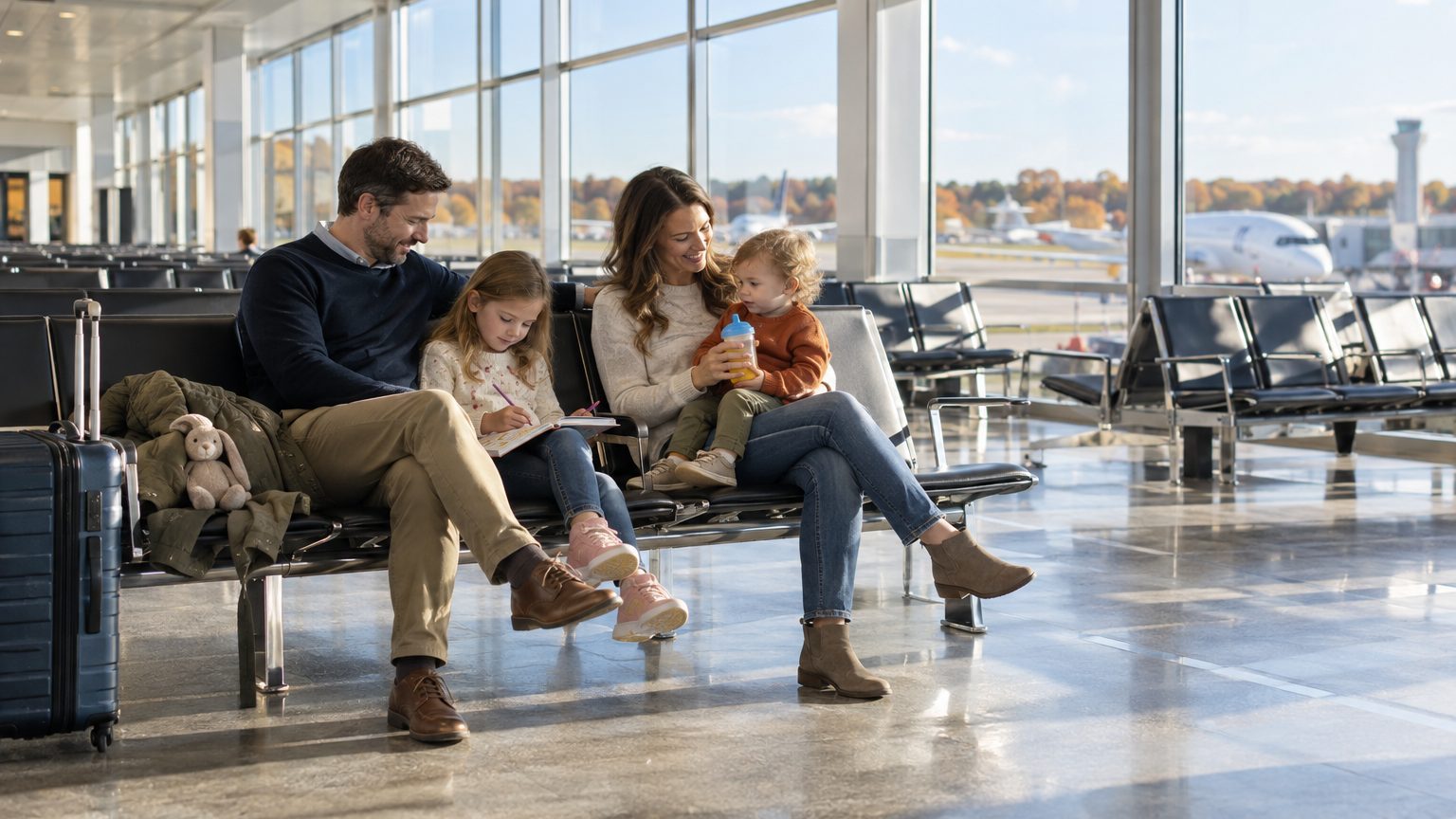
For a family flying at Thanksgiving or Christmas, four decisions do most of the work. Pick the quietest day your schedule allows. If the budget allows, buy a seat for every child, including those under two. Pack the airport-day essentials where you can grab them. Know what happens at the TSA checkpoint before you reach it. Everything below hangs on those four, and it builds on our broader holiday travel tips.
Flying with kids tips: choosing the day makes a big difference
Thanksgiving Day itself is the easiest day of the year to fly.
TSA’s checkpoint numbers show 1,559,165 people screened on Thanksgiving Day 2025, against 2,753,036 the day before and 2,392,036 the day after.
Three days later the picture flips:
the busiest day ever at US airport security was Sunday, November 30, 2025, when TSA screened 3,134,613 people.
That is more people in one day than live in Mississippi, all funneling through the same checkpoints and the same family restrooms.
The calendar for 2026 follows the same shape. Thanksgiving lands on November 26.
The busiest days to fly are Wednesday, November 25, for departures, and Sunday, November 29, and Monday, November 30, for the return.
The calmest day is Thanksgiving Day itself; Friday, November 27 is lighter than the peak days but still busy.
Those forecasts are projections built from past TSA counts. TSA and the airlines publish their own estimates closer to the holiday, so check again a week out.
A toddler does not care that Wednesday is the “traditional” travel day, and our guide to Flying With a Toddler explains why timing matters even more for the youngest travelers. Moving the outbound leg to Tuesday morning, or flying on Thanksgiving Day and eating dinner a little late, can shorten line time and cut meltdown risk. Parents with school-age children have more flexibility than they think, since some districts close for the whole week. The return leg is where most families get caught, because the Sunday after the holiday is the default for everyone with a Monday-morning obligation. Flying home on Friday or Saturday, or even the following Tuesday, is usually calmer than Sunday, though it may cost a day of vacation or work.
Time of day counts too.
Flying early in the morning usually means shorter lines.
Early flights also tend to run closer to schedule, which matters when a delay means entertaining a five-year-old on a terminal floor. Build a buffer:
arrive at least two hours early for a domestic flight, and add more on the busiest days.
Families with a stroller, a car seat and a diaper bag should treat that as a minimum. Our guide to flying with kids goes deeper on scheduling around naps and connections.
Seat selection is the other lever. Book everyone together at the time of purchase, because holiday flights fill fast and airlines can’t always seat a family together at the gate. If you are bringing a car seat, ask about window seats from the start, a rule explained in the next section.
Flying with a toddler: the seat question
Federal rules allow a child under two to ride in an adult’s lap. Federal safety guidance says not to.
The FAA states that the safest place for a child under two on a U.S. airplane is in an approved child restraint system, not in your lap.
The reason is physical:
your arms can’t hold an in-lap child securely, especially during unexpected turbulence.
The NTSB has pushed the point for decades.
It has issued safety recommendations since 1979 asking the FAA to require children under two to be in their own restrained seat.
The rule never changed. The advice is the thing to follow.
Money is why most families still choose the lap. A holiday fare for a toddler’s own seat can be steep, and the FAA has noted that
many families would drive instead of fly if forced to buy an extra ticket.
Driving carries its own risks, so the trade-off is real. If a ticket for your toddler fits the budget, buy it and bring the car seat. If it does not, a lap child is legal, and the airline may ask for proof of age. Some carriers,
such as Allegiant, require a copy of the birth certificate or a government-issued ID for children under 24 months.
Check your own airline’s policy.
Not every car seat qualifies. Look for the label.
Red text on the seat reads “This restraint is certified for use in motor vehicles and aircraft.”
Boosters are the usual exception, and a frequent mistake with older kids.
Booster seats and vest- or belt-type harness devices (other than the CARES harness described below) are not approved for use on airplanes.
A child who rides in a booster at home uses the regular airplane seat belt in the air.
Placement has rules, too. Allegiant’s published policy sums up common practice:
children in car seats must sit in a window seat, not in an aisle seat, and not in or directly beside an exit row.
Width can also be a problem. The same airline notes that
a car seat wider than 17.88 inches is unlikely to fit.
Measure yours before you leave, because a wide convertible seat on a regional jet can turn into an argument at the gate.
There is a lighter alternative for toddlers.
The CARES harness is FAA-certified for children up to 40 inches tall who weigh between 22 and 44 pounds.
It uses the aircraft seat belt, weighs far less than a car seat, and fits in a carry-on. The catch is that it works on the plane only.
It is not approved for use in motor vehicles
, so you will still need a car seat at the destination, whether you borrow or rent one. For a longer breakdown of ages, seats and sleep, see our full guide to flying with a toddler.
What to pack for a kid on a plane
The holiday carry-on has one job: keep a child calm, fed and dry for a flight that may run three hours late. The weight of it should be snacks, a change of clothes for the child (and one for the adult, since spills travel upward), wipes, and a few new or rarely seen small toys. Fresh novelty beats a favorite toy that the child already knows to ignore. Headphones sized for children, a tablet loaded before you leave, and a charged battery pack cover the long delays.
Liquids are where parents often overpack or discard things they were allowed to keep. TSA treats children’s drinks and feeding supplies as a special category:
liquid formula, breast milk, toddler drinks and baby or toddler food, including puree pouches
are allowed in reasonable quantities above the usual 3.4-ounce limit. Tell the officer at the start of screening. As one airport’s guidance puts it,
you should say you are carrying infant or toddler liquids over 3.4 ounces, and those items come out of your carry-on to be screened separately.
TSA also
can choose to test these liquids for explosives or concealed prohibited items
, so do not be surprised by a swab.
Cooling gear is covered as well.
Ice packs, freezer packs, gel packs and liquid-filled teethers are allowed in carry-ons.
Partially frozen or slushy packs face the same extra screening as other liquids, so freeze them solid the night before. A breastfeeding parent does not need the baby along to bring milk:
the child does not need to be traveling with you to bring breast milk and cooling accessories.
One packing choice deserves a firm opinion: put the diaper bag’s liquids in an outer pocket or a separate pouch. A bag where the formula is buried beneath the wipes is the bag that gets unpacked on the belt, with a line forming behind you. TSA’s own photo from a Philadelphia checkpoint shows a parent doing exactly that,
removing liquids from the outer pockets of a diaper bag and placing them in a bin for ease of screening.
For a fuller toddler packing list, see what to pack for a toddler on a plane.
Check the weather at both ends. A Thanksgiving trip from Atlanta to Minneapolis means a child in sneakers in the departure terminal and in snow boots on arrival. Pack the coat in the carry-on, not the checked bag, so a delayed suitcase does not leave a four-year-old shivering at the curb.
Kids airport security: what changes for children
The checkpoint is gentler on children than on adults, and knowing the specifics keeps you ahead of the line.
TSA has modified screening procedures for children who appear to be 12 or younger
, and
officers consult the parent or traveling guardian about the child’s screening.
The most visible change is clothing.
Children 12 and under can leave their shoes, light jackets and headwear on during screening.
That alone saves a minute of juggling at the belt.
Families are not split up.
Children will not be separated from their parent or guardian.
A child who can walk through the metal detector without help
may do so separately from the parent or guardian.
If a child alarms, officers have options beyond a pat-down:
children can pass through multiple times or undergo secondary screening techniques that reduce the chance of a pat-down.
Infants are another matter.
Parents should lift infants out of strollers and car seats and carry them through the metal detector, though a sling or carrier is allowed.
The gear goes on the belt.
Strollers, umbrella strollers, baby carriers, car seats, booster seats and backpacks must be screened by X-ray.
Fold the stroller and empty its pockets first. If equipment is too big for the machine,
it will get a visual and physical inspection by TSA officers.
The advanced imaging scanner is rarely a problem for younger children, with one exception:
a child who alarms or can’t hold the required stance for five seconds may need secondary screening.
Practice the “hands up” pose in the hallway if you have a wiggler.
PreCheck is worth a look if you fly often with kids.
Parents enrolled in TSA PreCheck may bring children 12 and under with them through a PreCheck lane.
Teens are less certain.
Children aged 13 to 17 can use the PreCheck lane if they are traveling with family and the boarding pass shows the PreCheck logo
, but they can be randomly sent to standard screening. Any minor traveling separately from a PreCheck parent needs their own status.
Parents often ask about ID. For domestic flights the rule is simple:
children under 18 do not need to present ID at the travel document checking podium.
International trips are different, since
every passenger, minors included, needs a valid passport.
Airlines can set their own rules for minors, and lap infants may need proof of age at check-in, as noted above. Details and exceptions are in do kids need id to fly.
One last nuance catches families with older teens. The no-ID rule stops at 18. A senior flying home for the holidays with a younger sibling, or a college student chaperoning cousins, falls under adult rules, and
passengers 18 and older must show valid identification at the checkpoint.
TSA’s list of acceptable IDs can change, so check it again before you leave rather than relying on last year’s trip.