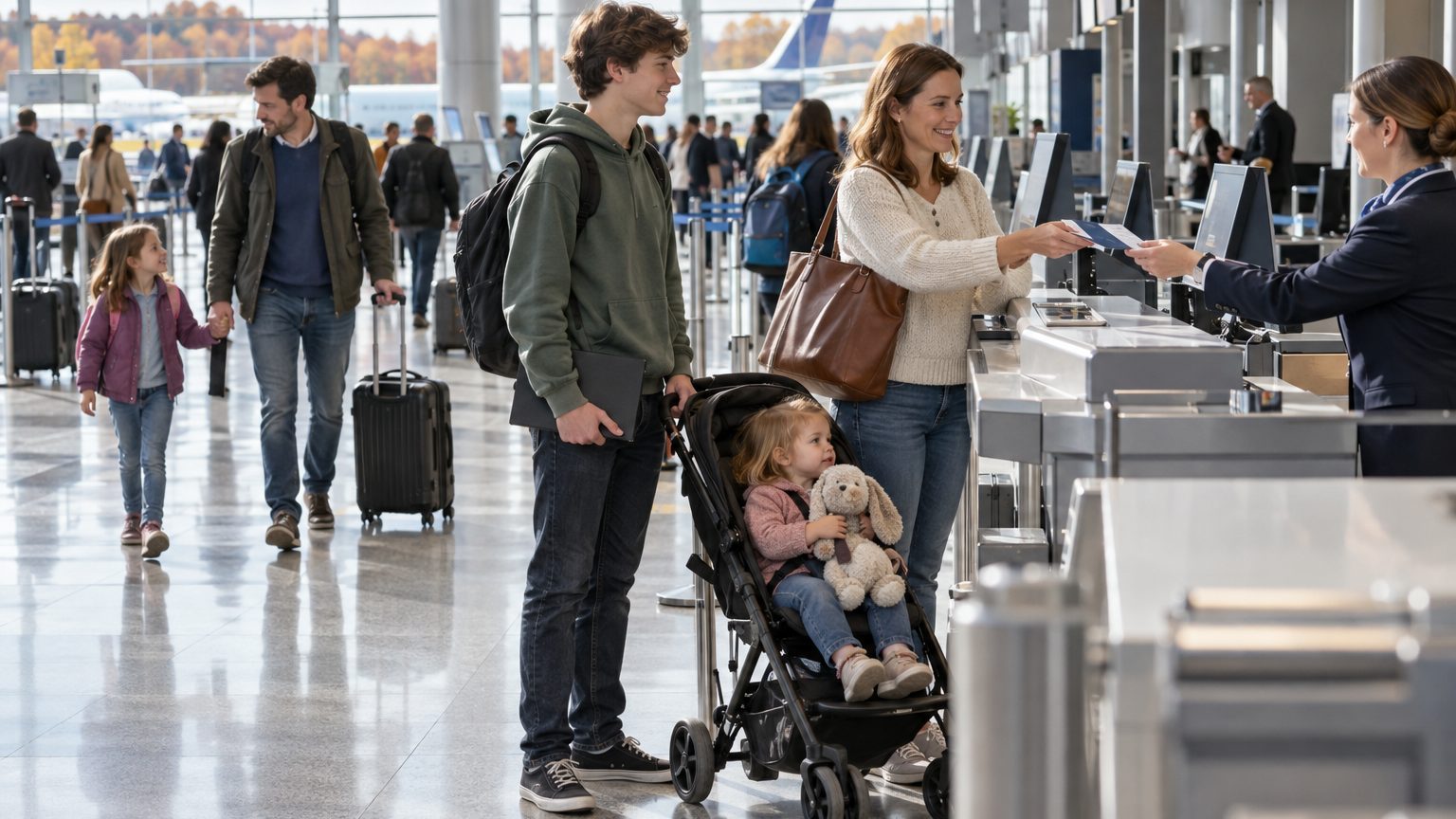
For domestic US flights, TSA does not require children under 18 to show ID, as long as an adult is traveling with them. Airlines can still ask for proof of age, which is why a lap infant under 2 should travel with a birth certificate. Once a child turns 18, TSA expects acceptable ID, now a REAL ID-compliant license or a passport. On any international flight, all air travelers, including newborn infants, are required to have a valid passport.
Three different authorities set rules here: TSA at the checkpoint, the airline at check-in and boarding, and CBP or the destination country at the border. Parents get tripped up when they treat one authority’s rule as everyone’s. “Kids never need ID” holds only for TSA. “A birth certificate is enough” holds only for certain land and sea crossings. The details matter even more during holiday travel with kids, when counters are crowded and nobody has patience for paperwork surprises.
TSA ID rules for minors
At the checkpoint, the adult’s ID does the work. A 17-year-old walks through without a card, and so does a 6-month-old. TSA does not ask for a child’s birth certificate either. Children 12 and under also get lighter screening, and can keep shoes, light jackets and headwear on.
Age 18 changes everything. An 18-year-old traveling with the family is an adult at the checkpoint and needs their own ID. REAL ID enforcement began on May 7, 2025, so that means a REAL ID-compliant license or another accepted document such as a passport. TSA notes that its list of acceptable IDs can change without notice, so check tsa.gov before a trip, especially if your teen plans to rely on a mobile ID.
A minor without ID causes no problem, and TSA does not separate children from the adults with them. The adult is the one who needs to be ready: a parent with no acceptable ID can still be screened through TSA’s alternative verification, but may have to pay for Confirm.ID.
PreCheck follows its own age rules. Family members ages 12 and under traveling with an eligible parent or guardian can join them in the PreCheck lanes without applying. Teens 13 to 17 must be on the same reservation as an enrolled parent or guardian, with the PreCheck indicator on their boarding pass. They may be randomly excluded and sent to standard screening. A minor flying alone must apply for PreCheck to get expedited screening.
Documents needed for kids to fly domestic
Airline policy is a separate layer. Carriers want to confirm that a lap infant really is under 2, or that a child qualifies for a discounted fare. Southwest, for one, asks for proof of age such as a birth certificate for lap infants under 2, even on domestic flights, and may require a purchased seat if you can’t show it. Other carriers check less often, but you can’t predict who gets asked at a busy counter.
Infants under age 2 can fly free on the lap of a paying adult on domestic flights. Carry the birth certificate (a paper copy or a clear photo is usually enough for a quick check), and keep it where you can reach it without unpacking. A child who turns 2 between the outbound and return flights needs a seat for the return. Logistics of the flight itself are covered in our guide to flying with a toddler.
Check names before you book. TSA’s Secure Flight program compares the traveler’s name, date of birth and gender on the reservation against government watchlists, so the name on the ticket should be the child’s legal name, the one on the birth certificate or passport. Nicknames, a swapped middle name or a missing hyphen are easy to fix with the airline before departure, but a nuisance at the airport.
Grandparents, aunts, uncles and family friends can fly with a child domestically without any letter required by TSA. Many families carry one anyway: a signed note from the parents with phone numbers and medical permission.
Kids flying international
The passport rule has no age exemption. A birth certificate won’t get a child onto an international flight, and neither will a passport card, which is valid only for land and sea entry. That includes short hops to Mexico or the Caribbean by air.
Getting a first passport takes planning. A child under 16 must appear in person with you and the child’s other parent or guardian, with Form DS-11 submitted at an acceptance facility. If one parent can’t come, that parent must complete Form DS-3053, the Statement of Consent, notarized and submitted within 90 days after it’s signed. The fees for a child’s passport book are $100 plus a $35 facility fee. Passports for children under 16 are valid for 5 years and cannot be renewed, so every replacement means a new in-person application. Teens 16 and 17 get 10-year passports and only need to show that at least one parent or guardian knows about the application. Check expiration dates early, because many countries want months of validity left.
The birth certificate exception is narrow. U.S. and Canadian citizen children under age 16 arriving by land or sea from Canada, Mexico or the Caribbean may present an original or copy of a birth certificate. Children under 19 traveling with a school, religious group, social or cultural organization, or sports team qualify too. Nobody can use this for air travel.
Consent letters are the gray area. Border officers, particularly in Canada, may question a child traveling with one parent or with another adult, and a notarized, dated letter from the absent parent granting permission answers that question quickly. A letter isn’t always legally required, but it is cheap insurance. Check Canada’s and Mexico’s official entry pages for the current wording, because those rules are set by the destination, not by the US.
Can a minor fly alone, and what ID does the airline require?
Yes, with limits. Major US airlines will not accept a child under 5 as an unaccompanied minor. American requires its service for ages 5 to 14 and makes it optional for 15 to 17, at $150 each way. Delta’s program is mandatory for ages 5 to 14 at the same price. Other carriers set different age cutoffs or fees, so check the airline’s own page before booking.
The adults at each end need ID. At drop-off, expect to show a photo ID and complete an unaccompanied-minor form. At pickup, the guardian listed on the form must be at least 18 and present an ID. The airline will not release the child to anyone else. If a gate pass is needed, Delta says a valid physical ID is required and digital ID is not accepted.
Teens 15 to 17 sit in the middle. TSA asks nothing of a 17-year-old at a domestic checkpoint, though some airlines still ask for proof of age. Internationally, a teen needs a passport like everyone else. Our guide to flying with kids over Thanksgiving and Christmas covers the busiest-day logistics.
What should you do if your child’s ID or documents are missing on travel day?
Start with the party that can actually fix the problem, in this order:
- The airline, before you leave home. For a missing birth certificate, ask whether a photo, a hospital record or a vaccination record would be accepted for a lap infant. Policies on domestic proof of age vary by airline.
- The airline counter, with what you have. Bring any backup: the digital copy, the birth certificate photo, the notarized consent letter.
- TSA, for the adult’s ID. A missing adult ID goes through identity verification at the checkpoint, which can take extra time and may carry a fee.
- The State Department, for a missing passport. The airline can’t waive a passport on an international flight. Look into urgent passport appointments and rebook.
Backups cost nothing. Store photos of the birth certificate, each passport and any consent letter on your phone and in cloud storage, and keep paper copies in a carry-on, never in checked luggage.
Quick checklist: documents by trip type and age
| Age and trip type | TSA ID required? | Airline document that may be requested | Passport needed? | Practical note |
|---|---|---|---|---|
| Infant under 2, domestic (lap) | No | Proof of age, often a birth certificate | No | Carry the original or a copy; some airlines check it routinely. |
| Child 2 to 17, domestic | No, with an adult | Usually none; proof of age if a child fare is questioned | No | The adult’s ID is what TSA checks. |
| 18 and older, domestic | Yes, REAL ID-compliant or passport | Government photo ID | No | An 18-year-old traveling with parents is treated as an adult. |
| Any child, international by air | No separate ID; the passport serves | Passport, plus any visa | Yes, even newborns | A birth certificate or passport card will not work for flights. |
| US citizen under 16, land or sea from Canada or Mexico | No flight, so no checkpoint | None | No; birth certificate accepted | Groups under 19 qualify; a consent letter helps with one parent. |
| Unaccompanied minor | No ID for the child under 18 | Completed form; photo ID of the adult at drop-off and pickup | Only if the flight is international | Rules, ages and fees vary by airline. |
Frequently Asked Questions
Does a child’s name on the ticket have to match their ID or passport?
It should match the child’s legal name. For domestic flights that means the name on the birth certificate, and for international trips it must match the passport exactly. Correct small errors with the airline before the day of travel.
Can grandparents fly with a grandchild without a parent’s letter?
For domestic flights, TSA does not require a letter, and most airlines don’t either. A signed note with the parents’ contact details and medical permission is still wise. On international trips, a notarized consent letter is strongly advisable and may be requested at the border.
Do kids need their own TSA PreCheck to go through the PreCheck lane?
Not if they’re with an enrolled parent or guardian. Children 12 and under join without applying. Teens 13 to 17 need to be on the same reservation, with the PreCheck indicator on their own boarding pass.
Is a passport card enough for a child flying internationally?
No. A passport card works only for land and sea entry. Every child on an international flight needs a passport book.
What ID does the adult need to pick up an unaccompanied minor?
The adult must be named on the airline’s form, be at least 18, and show a government photo ID.
Sources: cbp.gov | common.usembassy.gov | federalregister.gov