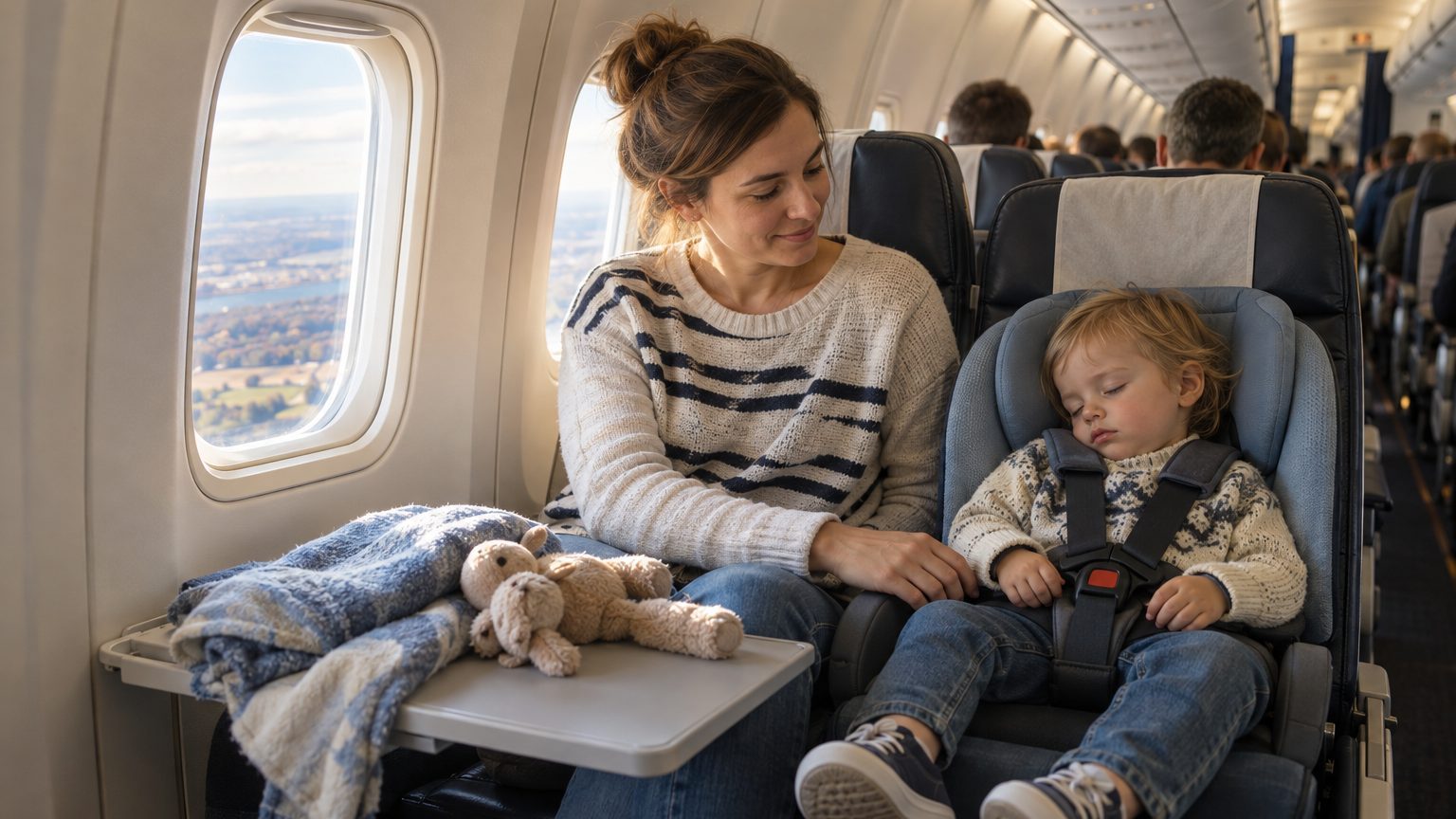
The safest way to fly with a toddler is to buy a ticket for the child and strap them into a restraint approved for aircraft. The FAA, the NTSB and the American Academy of Pediatrics all say so. You aren’t required to, though.
Children under age 2 may travel as a lap infant on domestic flights.
Most of the planning comes down to that one decision. It sets your ticket cost, your seat choice and how much you carry.
Lap infant vs own seat
Start with the legal baseline, because it is more permissive than most parents expect.
The FAA doesn’t require a ticket for children under 2 years, which means the airline can’t stop you from holding your baby in-flight.
A child who has turned 2 is different.
Children who have reached their second birthday must travel in their own seat and have a purchased ticket.
If your toddler turns 2 between the outbound and return flights, the return leg needs a ticket, so check the birth date against both travel dates when you book.
A lap child still has to be on the reservation.
Regardless of whether you buy a ticket for your baby, children under 2 still need to be added to the airline reservation.
Also, one adult can hold only one lap child.
The money is the obvious reason families choose a lap seat. Domestic lap infants usually fly free or close to it. The safety case for paying anyway rests on turbulence.
Turbulence is the leading cause of children’s injuries on airplanes.
The FAA puts it bluntly:
your arms aren’t capable of holding your in-lap child securely, especially during unexpected turbulence.
The NTSB has pushed on this for decades.
It has issued safety recommendations since 1979 asking the FAA to require that children under age 2 be in an appropriately secured child restraint in their own seat.
The FAA hasn’t made it a rule, so the choice is yours.
A toddler on your lap also has to be held for takeoff, landing and any turbulence, and a squirming 25-pound child doesn’t make that easy. A ticket does more than buy safety. It gives the child a space to sleep, and it guarantees the car seat can come on board.
Purchasing a seat for your child is the only way to guarantee that a CRS can be used onboard.
Some airlines let a lap infant use an empty adjacent seat if one happens to be open. That’s luck, not a plan, especially on full holiday flights.
Which restraint, and how to check it
You have two options for a child in their own seat. One is a car seat.
Confirm your child’s seat has “This restraint is certified for use in motor vehicles and aircraft” printed on it
, or that a foreign-approved seat carries its required marking. Look for that sticker before you leave home, not at the gate. The other option is a harness.
The CARES device is FAA-certified for children up to 40 inches tall who weigh between 22 and 44 pounds, and it works with the existing aircraft seatbelt.
It weighs far less than a car seat, which helps if you’re relying on rental-car seats at your destination.
The FAA’s current guidance on choosing a restraint is simple.
It advises choosing a restraint that fits the child and following the manufacturer’s instructions.
Check your seat’s manual for its height and weight limits and any aircraft-use notes. Then confirm the seat fits. Airlines must post seat dimensions online, so compare the width of your seat to the airline’s listing for your aircraft type.
Placement matters too.
For a child in a rear-facing car seat, the window seat is best so it doesn’t block anyone’s exit in an emergency.
Sitting together is less automatic than it sounds. The U.S. Department of Transportation runs an online dashboard showing
which airlines guarantee two seats together at no extra charge when an adult is traveling with a child 13 or under.
Look at it before you pick an airline, not after.
What to pack for a toddler on an airplane
Pack for delays, not for the scheduled flight time. A two-hour flight can turn into six hours with a tarmac wait, a missed connection or a holiday-weekend rebooking. The carry-on should hold enough diapers, wipes, snacks and clothing to get a toddler through a full day with no checked bag. A spare outfit for your toddler is the standard rule. Add a spare top for yourself, because spills and leaks can land on you too. Our guide on what to pack for toddler on plane has the full checklist. This section covers the items that affect airport security and the cabin.
Food and drink are where TSA rules help you.
Formula, breast milk, toddler drinks, and baby/toddler food (including puree pouches) are allowed in carry-on in quantities over 3.4 oz (100 ml).
Cooling accessories such as ice packs, freezer packs and gel packs are also allowed.
These items do not need to fit within a quart-sized bag.
The process takes a few steps.
Tell the officer at the start of screening that you’re carrying these items in amounts over 3.4 oz, and take them out of your carry-on for separate screening.
Liquids may be tested. TSA also suggests
clear, translucent bottles for formula and breast milk when possible
, which are simpler to screen than pouches. An opaque sippy cup of juice slows the line for everyone.
Screening is gentler for small children.
Children 12 and under can leave their shoes, light jackets and headwear on during screening.
Parents will not be separated from their children at security checkpoints.
If you’re enrolled in PreCheck, your children can use the PreCheck lane with you. Strollers and car seats
are screened and may need to be folded
, so practice collapsing yours before travel day.
A few small items earn their space on a toddler flight:
- A light blanket or layer, since cabin temperature swings from cold to warm.
- A bottle, sippy cup or snack ready for takeoff and descent.
- A pacifier or comfort item if your child uses one.
- Any medications with their original labels, in your carry-on.
Ear pressure can make a toddler miserable.
Just like adults, babies may experience discomfort in their ears as a result of air pressure changes during takeoff and landing; sucking and swallowing can ease the pain.
A drink, snack or pacifier timed to the descent often helps more than a toy. If your toddler has recently had an ear infection or ear surgery, ask your pediatrician before booking.
Confirming with the pediatrician is particularly worth doing if there have been recent ear infections or ear surgery, or heart or lung conditions.
Don’t forget the car seat itself. If your toddler has a ticket, it goes on board. If not, many airlines let you check it without a fee, but a checked seat can be damaged or lost, so a seat you have to use at the destination is better kept with you if possible. Our guide to flying with kids during the holidays covers what changes during the busiest weeks of the year.
How to keep a toddler busy on a plane
Toddlers don’t sit still, and a flight asks them to. A common mistake is to bring one big distraction and deploy it in the first ten minutes. A better approach is to carry several small, new-to-them items and release them one at a time, saving the best for the last third of the flight. A sticker book, a small set of board books, or a handful of washable crayons with a pad can each buy a stretch of calm. They take up almost no room.
Movement helps as much as toys. Walk the aisle when the seat belt sign is off, and take a turn near the galley if the crew allows it. Choose seats away from the busiest part of the aisle if you can. The window is often the calmest spot, since it is
farther from aisle traffic, food carts, and potential spills.
A window also gives a toddler something to watch during taxi and climb, which are often the hardest minutes of the flight.
Screens have a place. Download shows or games before you leave the house, since Wi-Fi is unreliable, and bring headphones sized for small ears. Keep the tablet in reserve for a rough patch rather than starting the flight with it.
Timing is one of the biggest levers you have. Many families book flights that overlap with nap time, hoping the child sleeps through. It works when the child has their own seat and the car seat is familiar, because they can recline and settle in a way they can’t on a lap. The same applies to mealtimes. A hungry toddler is a loud toddler, so board with a full stomach if you can.
One last point on safety: if you do decide to hold a child on your lap,
harness-type or lap-held devices are not allowed during take-off, landing, or while taxiing.
Don’t plan on a loop belt or a baby carrier worn for takeoff. Anything other than an approved seat or harness won’t count.
Sources : tsa.gov