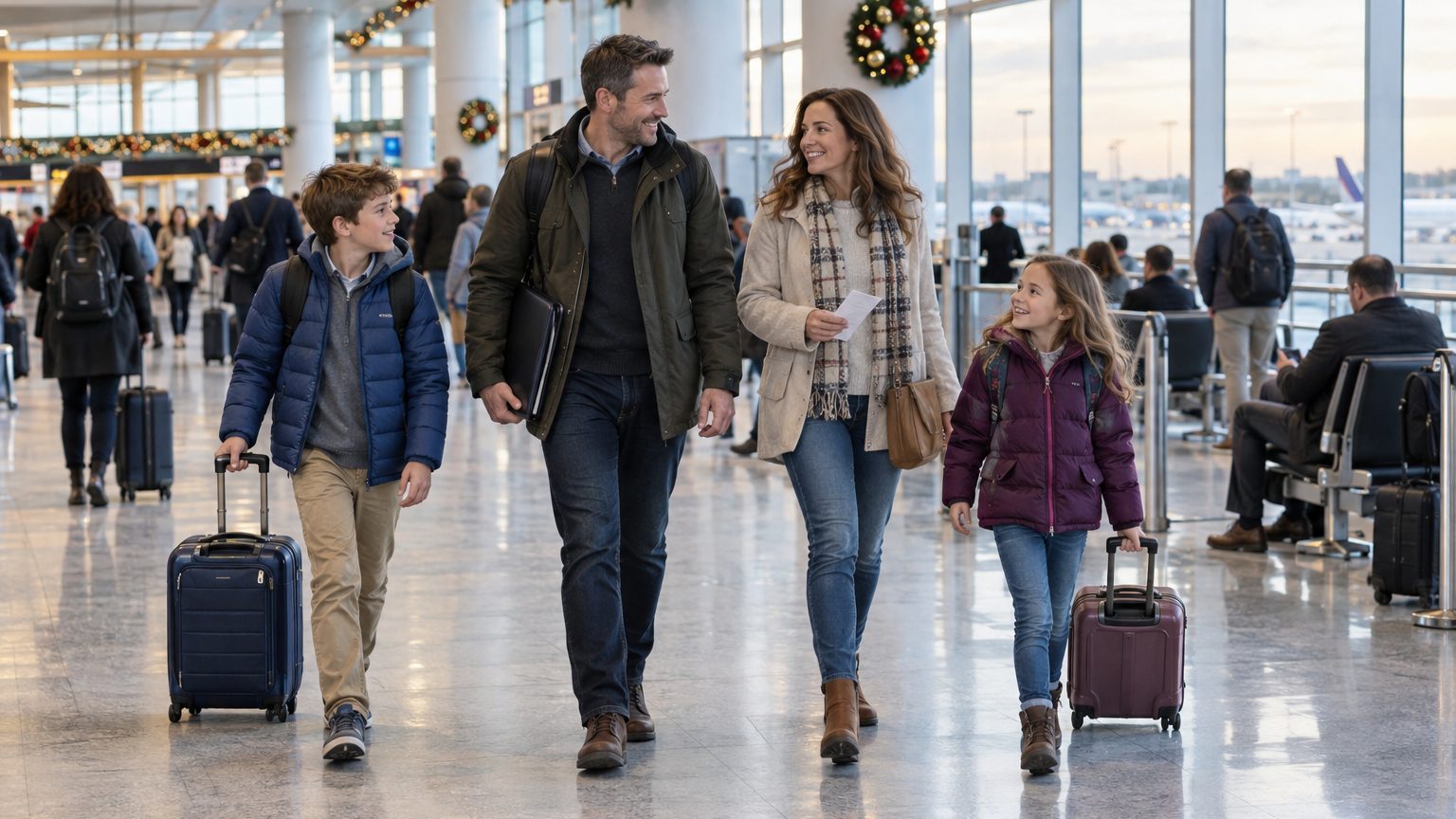
For school-age kids, a holiday flight comes down to three decisions. Pick the quietest workable day, give each child a bag they can carry themselves, and bring the right paperwork. On the paperwork,
children under 18 do not need to present ID at the travel document checking podium
on a U.S. domestic trip, but the adults with them do. Thanksgiving 2026 falls on Thursday, November 26, and the Sunday after it, November 29, is the date most likely to bring the biggest crowds. The rest of this guide covers what to do around that. (For the bigger picture, including driving and hosting, see holiday travel with kids.)
Flying with kids tips for Thanksgiving and Christmas
Start with the calendar, because it is the one variable you control for free. TSA screened
3,134,613 people on Sunday, November 30, 2025
, the all-time record, which is more than the population of Chicago passing through security in a single day. Three days earlier,
1,559,165 people were screened on Thanksgiving Day 2025, against 2,753,036 the day before and 2,392,036 the day after
. Thanksgiving Day itself moves at roughly 57 to 65 percent of the volume of the days on either side. A morning departure on the holiday itself trades a bit of family time for shorter lines and calmer children.
Christmas follows a similar logic, though no official forecast exists yet for it. The holiday itself is likely to be lighter than the days on either side, so check fares and flight loads for December 24 and 25 against the weekend before.
Seats come next, and this is where school-age kids get stranded. The Department of Transportation tracks which carriers promise free adjacent seats.
As of August 2026, five airlines hold the green check: Alaska, American, Frontier, Hawaiian and JetBlue.
The promise comes with conditions.
The child and adult generally need to be on the same reservation, and the adult must either choose seats for the entire reservation or skip seat selection entirely
. Changing only some assignments can void the guarantee. It also covers one child and one adult, so
a parent with two or more children can have one child seated separately without the airline breaking its commitment
.
Airlines outside that group still have policies. One large carrier’s basic economy page says
up to two children under 12 can sit next to the first adult on the reservation at no charge, selected after booking
. Two other big carriers use a “best effort” approach that can leave kids nearby rather than beside you. Read the fare rules before you click purchase, not at the gate.
At the checkpoint, kids get some breaks.
TSA has modified screening procedures for children who appear to be 12 years old and younger
, and
children will not be separated from their parent or guardian
. If a child alarms in the scanner,
they get a chance to go through again, or the officer may use other procedures to reduce the need for a pat-down
. TSA’s children’s page says those 12 and under can keep shoes, light jackets and headwear on. Note that
for body-scanner screening, light jackets must come off and go on the X-ray belt
. TSA also dropped its general shoes-off requirement in 2025, so many adults now keep theirs on too, although
a traveler may still be asked to comply with additional screening, including shoe removal
. Tell your kids to follow the officer, not the rule they heard last year.
TSA PreCheck changes the math for families.
Parents or guardians enrolled in PreCheck may bring their children with them through a PreCheck lane.
Teens are the exception.
Children between 13 and 17 could be randomly excluded from PreCheck and will have to pass a standard screening
, and
they must have the PreCheck logo on their boarding pass
.
One safety point that surprises parents of older kids: the FAA’s guidance centers on harnessed restraints for children under 40 pounds. A booster doesn’t count.
Booster seats cannot be used on airplanes during flight
, so a school-age child still in one needs it checked or gate-checked, and rides in the regular seat with the lap belt. Plan for a loaner or rental at the other end if you need one for the car.
What goes in a kids carry on bag
Every child old enough to wear a backpack should carry their own. It teaches ownership, it frees your hands for boarding passes and coats, and it spreads the entertainment load. One rule applies to every bag, whoever it belongs to:
carry-on property of all passengers, regardless of age, must be screened
, and
backpacks, strollers and car and booster seats must go through the X-ray
. Nothing rides through in a child’s arms except the child.
Size matters before the airport. Personal item limits vary by airline, and cheaper fares can restrict what you bring on board, so measure the backpack against the carrier’s published dimensions. A pack that slides under the seat in front, without squeezing a neighbor’s feet, is the target.
Liquids are the second trap. The 3-1-1 rule applies to kids as much as adults:
a quart-sized bag of liquids, aerosols, gels, creams and pastes is allowed through the checkpoint, limited to 3.4 ounces (100 milliliters) or less per item
. In kid terms, that covers more than shampoo. Toothpaste, lip balm tubes, hand lotion, a pudding cup and a squeeze pouch of applesauce all count as liquids, gels or pastes. The easy workaround is an empty reusable water bottle filled after security, plus dry snacks such as crackers, pretzels, granola bars and fruit leather.
The exemptions are built for little ones.
Formula, breast milk and juice for babies and toddlers are allowed in larger than 3.4-ounce quantities, but must be declared and removed from carry-ons during screening.
A ten-year-old’s oversized juice bottle is a different case, so assume the standard limit applies to drinks for school-age kids. If you also have a younger sibling in tow, the checklist in what to pack for toddler on plane covers those exemptions in detail.
For the contents, think in layers: something to watch, something to read, something to do with their hands, and something to wear. Download shows and games before leaving, since in-flight Wi-Fi is unreliable and holiday flights are full. Pack wired headphones or a pair with a volume limiter, and add a charger and a short cable. A paperback, a sticker book or a deck of cards covers the stretch when the tablet hits 5 percent. Add a hoodie (cabins run cold), a spare shirt in case a drink tips, and a small zip bag of tissues and wipes. Then put the two or three things you would hate to lose, like a phone charger or medication, in your own bag, not theirs.
Do kids need ID to fly?
For domestic flights, no. TSA’s own guidance states that
children under age 18 do not need to present ID at the travel document checking podium
. That includes teenagers, who often assume the rules change at 16. The adults are another story.
REAL ID enforcement began on May 7, 2025, and passengers 18 and older must present a REAL ID-compliant license or another acceptable form of identification.
A passport or passport card works, so grandparents flying with the grandkids should check the star on their license before packing.
Skipping this step now costs money.
Starting February 1, 2026, TSA levies a $45 fee on adults who try to fly domestically without a REAL ID or another accepted form of identification, to use an alternative verification system called TSA ConfirmID.
That verification is valid for a 10-day travel window, so a trip longer than 10 days may mean paying again for the return.
TSA said that before the fee began,
roughly 6% of travelers did not have a REAL ID or other acceptable identification
. For a family of four with two adults, a forgotten card can mean $90 and a lot of stress at one of the busiest airport weekends of the year.
The airline can still ask questions the TSA does not. For children under 2 on a lap,
airlines will require proof of age, such as a birth certificate
. If a toddler is part of your trip, see flying with a toddler for the lap-versus-seat decision. For school-age children, a photo of the birth certificate on your phone is cheap insurance if the last names differ or a grandparent is the travel companion. Some airlines also set their own policies for minors, and
most major carriers offer a fee-based unaccompanied minor program that includes an escort to and from flights
, so ask early if an older child is flying solo to a relative’s house.
International trips are a different category.
All children, regardless of age, must have a valid passport to fly internationally.
Passports for children under 16 are valid for five years, not ten, and
for children under 16, both parents must appear in person, or the absent parent must provide notarized consent (Form DS-3053)
. If a holiday trip to Mexico, Canada or farther is on the calendar, that appointment is often the longest lead-time item on this whole list. Also look into a notarized consent letter when only one parent travels with the child.
One last date check before you leave for the airport: the rules above flip at age 13. A child who turns 13 in the weeks before departure leaves the modified-screening category, and PreCheck access with a parent is no longer automatic. Look at the birthdays on your reservation, and treat any teen as a standard-screening traveler who needs the PreCheck mark on their own boarding pass.
Sources : tsa.gov | www4.erie.gov | tsa.gov