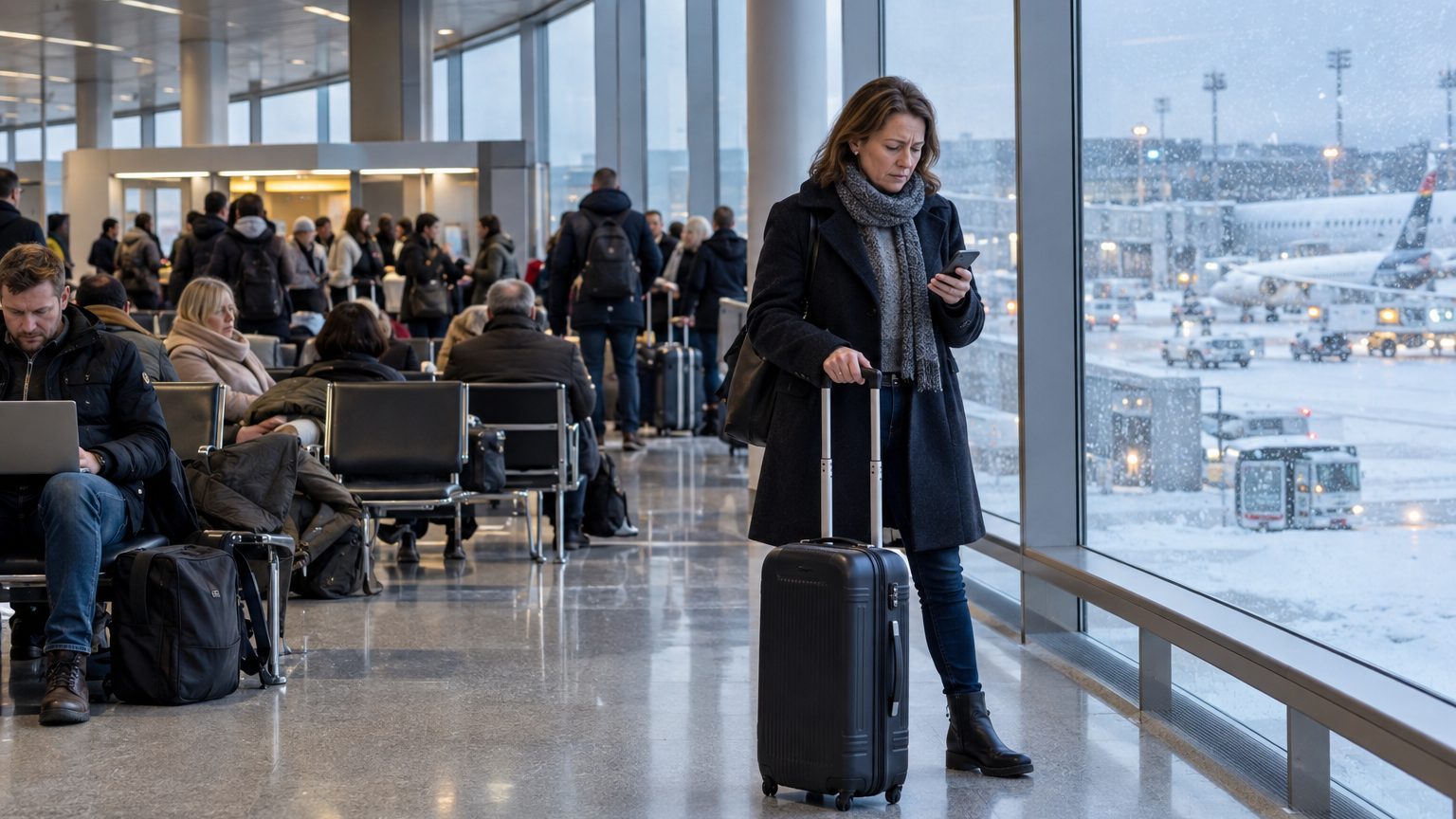
A winter storm that leaves you with a flight cancelled due to weather does not cancel your right to a refund. It does cancel most of the extras. Under U.S. Department of Transportation rules,
if an airline cancels a flight or makes a significant change, regardless of the reason, it must promptly refund a ticketed passenger who declines the alternative offered, including passengers holding non-refundable tickets.
Hotels and meals are another matter.
Airlines in the U.S. generally provide hotel and meal vouchers only when the cause is within their control
, such as a crew shortage or a mechanical fault. Snow and ice don’t qualify.
Most of the useful decisions happen before you reach the airport. Know which rights are firm and which are goodwill, and you can act hours before the crowd at the rebooking desk does.
Flight cancelled due to weather: what you are owed and what you aren’t
Scale explains why the airport turns chaotic. During the January 2026 storm,
airlines canceled more than 14,000 U.S. flights scheduled for a single weekend
, and
the stretch was described as the worst for cancellations in half a decade.
A month later, a blizzard on the East Coast hit hard enough that
more than 4,900 U.S. departures on one Monday, close to 20% of the national schedule, were scrapped.
When one flight in five disappears, phone lines jam and the airport app becomes your best tool.
The refund rule is the strongest protection you have. The DOT’s automatic refund requirements took full effect on October 28, 2024. Airlines must return your money
within 7 business days for credit card payments and within 20 calendar days for other forms of payment.
The money goes back to the original form of payment, so a voucher should not be your only option. The refund is also an either/or choice.
You have to decline any alternative flight or travel credit the airline offers, and accepting either costs you the automatic refund.
What counts as a “significant” change? Reporting on the rule puts the threshold at
three hours or more for domestic trips and six hours or more for international flights
, with a cancellation qualifying outright. A change of flight number can also matter.
Under the rule’s text, a flight reassigned a different number than the one you bought is treated as a new flight, and the original counts as cancelled. However, DOT has said it will not enforce that point through July 7, 2027, as long as you are rebooked under the new number and the flight operates without a significant change or delay.
Beyond the refund, the safety net gets thin. The DOT keeps a public Airline Customer Service Dashboard, which lists what each major carrier promises when the airline causes a disruption. Those promises include rebooking on the same airline at no cost, meal vouchers after a wait of three hours or more, and hotel and ground transportation for overnight cancellations. They apply to controllable events. For weather,
these benefits are not guaranteed.
Some carriers will help anyway, especially in a regional shutdown, but you can’t demand it. Many travelers assume otherwise, and they pay for their own hotel room as a result.
One more detail matters if you booked through a third party.
Airlines owe automatic refunds, while ticket agents must provide refunds on request when the airline cancels or significantly changes a flight and you don’t accept the alternatives.
If you booked through an online agency, expect to ask. The full refund-and-rebooking walkthrough is in our guide to a flight cancelled due to weather.
What to do if your flight is delayed before it’s cancelled
Delays are the grey zone. A flight that’s two hours late can still become a cancellation by midnight, and the airline owes you nothing for the wait. So the first move is to treat a weather delay as a warning, not an inconvenience.
Start with the airline’s travel waiver. Before big storms, carriers publish advisories that let passengers change flights without the usual penalties. In January 2026,
American, Delta, JetBlue, Southwest, United and others waived change and cancellation fees and fare differences for tickets to and from more than 40 airports, including restrictive basic economy tickets.
That last point matters because basic economy normally restricts or bars changes. A waiver also has fine print. One carrier’s version, for example,
covered a dozen cities and required that original travel plans be made before a set date.
Another
waived fees only if customers didn’t change their origin and destination, and left the fare difference to the traveler.
Read the conditions rather than assuming.
The timing advice from travel experts is consistent. Changing early beats waiting. As one travel expert told FOX Weather,
proactively changing flights before cancellations hit saves frustration.
Waivers generally make it easier to rebook yourself
without a fare difference, change fee or cancellation penalty.
If your itinerary connects through an affected hub, such as Atlanta, Charlotte or New York, the waiver often covers you even if your origin and destination are clear.
When the delay is already happening, keep a short log. Write down the scheduled arrival time at your final destination, the new estimated time, and every gate or time change. A guide from a passenger-rights company advises you to
note the arrival time at your final destination and save receipts for extra expenses caused by the disruption.
The same source also suggests you
avoid signing documents or accepting offers that may waive your passenger rights.
A record of the delay settles disputes about the 3-hour threshold, and it supports an insurance claim later.
Keep one more number in mind: hours until your next obligation. A hotel check-in, a rental car pickup or a connecting cruise sets your real deadline, regardless of what the airline says. We cover the hour-by-hour decisions in what to do if your flight is delayed. If your trip falls in late November or December, the holiday travel tips explain how peak crowds make every one of these steps harder.
Rebooking a cancelled flight: the order that works
Three channels compete for the same limited seats: the app, the phone line and the airport counter. Use all three at once. The app is usually fastest because the airline often offers automatic rebooking options after a cancellation, and it lets you accept one without waiting. If the options are poor, call while you stand in line. Whichever responds first wins, and you can drop the others.
Know what you’re looking for before you reach an agent. Look at the airline’s own schedule for alternatives, including flights through a different hub and flights on another day. Agents have the power to put you on a different routing, but they move faster when you hand them a specific flight number. The dashboard shows that many large carriers commit to
rebooking on the same airline at no additional cost
for controllable cancellations, though some also commit to rebooking on partner airlines. During weather events, the same-airline rebooking is typically the standard, and a switch to a rival carrier is a favor, not a right.
Then comes the hard decision: take the rebooking, or take the refund. Each has a cost. If the earliest seat is three days away, you may be better off declining it, requesting your cash and buying a ticket elsewhere. Be careful, though. Last-minute fares during a storm recovery can cost far more than your original ticket, and the refund only covers what you paid. Travelers who must reach a wedding or a connecting international flight often accept a worse itinerary on the original airline because it keeps their luggage, loyalty status and booking intact.
If the airline offers a voucher or credit instead of cash, say no unless you actually want it. Consumer advice from the DOT’s own framework is simple. The refund goes to the original payment method unless you affirmatively choose a credit. If the carrier doesn’t comply,
you can file a complaint with the DOT at transportation.gov.
Keep screenshots of the cancellation notice, your refund request and any response.
For the full sequence, including what to say at the counter, see rebooking a cancelled flight.
Travel insurance for weather delays: what pays when the airline won’t
This is where insurance fits. The airline’s obligation ends at the refund or the rebooking. Insurance covers the costs in between. As one personal-finance guide puts it, unlike airline policies, which only cover delays under the carrier’s control,
trip delay insurance also covers delays caused by weather or other unforeseen events.
If a storm grounds your flight overnight, a policy might pay for
meals and a hotel room, transportation to and from the airport, and necessities like medicine or toiletries.
Read the waiting period first. Most policies don’t pay for brief delays. Industry sources give different ranges, which tells you something about how much policies vary. One says delays
typically need to last at least 3 to 12 hours
, while another puts the usual minimum at
between 6 and 12 hours.
A delay of 4 hours under a 6-hour policy pays nothing. The dollar limits are modest, too. One guide lists per-day limits of
$100 to $300, and total policy limits from $500 to $1,500.
That’s enough for a hotel and dinner, not for a week of stranded lodging.
Credit cards matter here. Trip delay coverage often comes as a free card benefit instead of a separate premium. A cardholder guide describes one major issuer’s protection as
limited to $500 per covered trip
, with eligibility tied to a delay of more than 12 hours or an overnight stay in that example. Benefits differ by card, so check your card’s guide before you rely on it. And pay for the flight with that card, because the benefit usually requires it.
Cancelling the whole trip is a separate question. Policies typically require something more drastic than snow. One insurer explains that when severe weather stops your carrier from getting you to your destination for
at least 24 hours from your original scheduled arrival, that can be a covered reason for trip cancellation.
Others require a complete cessation of services. A forecast alone rarely qualifies, and a storm that’s already named before you buy is generally excluded because it’s foreseeable. A comparison site notes that the delay
must stem from an event that was unforeseeable when you purchased the policy.
If you want protection against simple fear of a forecast, the option is Cancel For Any Reason coverage. It reimburses a portion, commonly
50 to 75% of prepaid, non-refundable trip costs
, and you generally must buy it within a time-limited window after your first trip payment. The price is steep:
on a $200 policy for a $5,000 trip, CFAR adds roughly $80 to $100.
For a $400 weekend flight, that’s overkill. For a prepaid family holiday in a snowbelt city in December, it may be worth a quote.
Compare policies before the season starts, not during a storm warning. Our breakdown of travel insurance for flight cancellation shows which clauses to check.
One last practical note: file claims quickly and attach your record. Insurers ask for proof of the delay’s cause and length, so the airline’s cancellation email and your receipts are your evidence. Screenshot the flight status page when it shows “cancelled due to weather,” because that status can change or disappear once the flight is rebooked or removed.
Sources : yahoo.com | aviationtoday.in | gulfnews.com