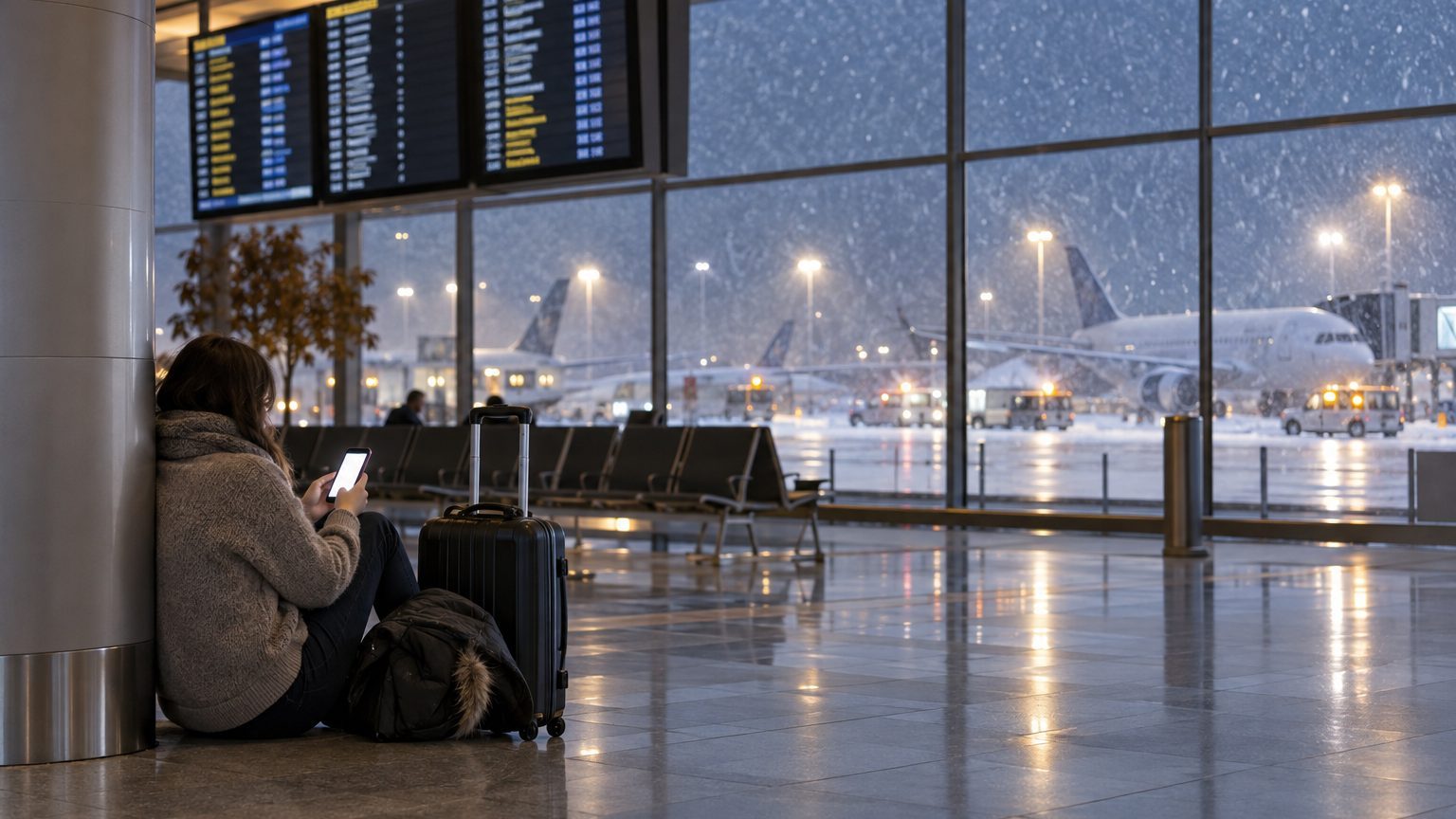
A flight cancelled due to weather still earns you a full cash refund if you don’t take the airline’s alternative. That’s the federal rule, and the cause of the cancellation doesn’t change it.
The Department of Transportation says any cancellation or significant change is eligible regardless of the reason, and that includes weather-related cancellations.
What the rule doesn’t give you is a hotel room, a meal or any cash on top of the fare. The airline can still offer those, but federal rules don’t require it.
That gap matters most in late November and late December, when one storm over Denver or Chicago can wipe out hundreds of flights and leave families sleeping on terminal floors.
Winter weather was the initial trigger for Southwest Airlines’ operational meltdown over the 2022 holidays.
Knowing where your rights start and stop before you reach the gate lets you ask for the right thing the first time.
Do airlines refund for cancelled flights due to weather?
Yes, with one condition. The refund applies when you choose not to travel.
DOT’s rule says a passenger is entitled to a refund when a flight is canceled or significantly changed and they no longer wish to take that flight or be rebooked.
Take the replacement flight and the refund obligation disappears. Decline it and the airline owes you your money.
The refund also has to be easy to get.
DOT requires refunds to be automatic, prompt, in the original form of payment, and in the full amount paid.
You shouldn’t have to hunt for a web form or sit on hold.
Airlines have seven business days to refund credit card purchases and 20 calendar days for other forms of payment.
The regulation counts the card deadline in business days. If nothing has shown up on your statement after that window, contact the airline and cite the automatic refund rule by name.
Delays work the same way, with a threshold.
Domestic flights delayed three hours or more, and international flights delayed six hours or more, qualify for automatic refunds if you don’t accept alternative transportation or travel credits.
A two-hour thunderstorm hold doesn’t qualify. A four-hour ground stop that wrecks your connection does, provided you walk away from the trip.
Watch for the voucher trap. Some airlines have a habit of defaulting to a travel credit, which feels like a refund until you try to use it on a competitor.
Before the rule, some airlines gave a credit or voucher by default, so passengers couldn’t use that money to rebook on another airline without a cumbersome request process.
If a cancellation notice offers only a credit, reply that you want the cash refund. Take the credit only if you actually plan to fly that airline again.
Two limits are worth knowing. The refund covers what you paid the airline, so a nonrefundable resort deposit, a rental car or a pre-paid tour stays your problem. That’s where travel insurance for flight cancellation comes in. And the rule covers flights to, from and within the U.S., on budget carriers as well as the big ones.
Rebooking a cancelled flight
Here the picture is less clear. Rebooking after a weather cancellation is whatever the airline’s own policy says, because there’s no federal mandate behind it. In practice, almost every airline will put you on its next flight with an open seat at no charge. DOT’s dashboard shows that
the ten largest airlines guarantee meals and free rebooking on the same airline
when the airline caused the problem. Weather isn’t in that category, but many carriers waive change fees and fare differences for weather events anyway, often through a travel waiver posted on their website before a big storm.
The phrase “on the same airline” matters. Nothing requires an airline to put you on a competitor’s plane, even if the competitor has seats tonight and your airline can’t get you out until Thursday. Some carriers will do it at an agent’s discretion, and asking costs nothing. Be specific and polite: “Is there any partner or interline option that gets me there sooner?” beats “Can you fix this?”
Speed decides most outcomes during holiday storms. Seats on the next two or three days of flights disappear fast, and a phone queue can run for hours. The practical order of operations looks like this:
- Check the airline app first. Automatic rebooking often appears there before an agent can reach you.
- If the app offers a flight you can live with, accept it quickly. If it doesn’t, call the airline while you stand in the gate line, not after.
- Screenshot the cancellation notice and any waiver terms. You’ll need them if you later argue for a refund or an insurance claim.
Think carefully before you accept a rebooking you don’t want. A flight on the 27th when you needed to be home on the 24th is an alternative on paper, but it may not be one you can use. If it doesn’t work for you, decline it and ask for the refund. You can then buy a new ticket elsewhere, though that fare could cost much more at holiday prices. Compare the price of that new fare against a long wait on the original airline before you decide. The winter flight delays guide covers how to read the situation when a storm is still developing, and the steps for a plain delay are in what to do if your flight is delayed.
Hotel voucher for cancelled flight
Weather is where hotel hopes usually end. The airline commitments tracked on DOT’s dashboard apply to what the agency calls controllable disruptions, such as crew or maintenance problems.
All ten of the largest airlines guarantee meals, and nine guarantee hotel accommodations, when an airline issue causes the delay or cancellation.
A blizzard is not an airline issue, so those guarantees usually don’t kick in.
When a disruption is caused by weather or other factors outside an airline’s control, a carrier may not be willing to pay for a hotel night or extra meals.
That doesn’t mean you should skip asking. Agents have discretion, and the answer sometimes depends on how the cancellation is coded in their system. Ask whether the airline can provide a discounted rate at a partner hotel, a meal voucher or a ground transportation voucher. A “no” costs you nothing, and a “yes” can save real money on a holiday night.
The dashboard’s red and green marks have a catch.
A red “X” doesn’t necessarily mean the service can’t be offered at all.
Agents can still say yes. Treat the dashboard as the minimum you can demand when the airline is at fault, not the maximum you can ask for.
A rule change that muddies the cause
A newer DOT rule affects how some cancellations are labeled, and it’s worth knowing about, though it doesn’t touch weather directly.
It creates a new reporting category for the ten causes of delay and cancellation that the 2024 FAA reauthorization law excludes from the Air Carrier category.
Weather already sits outside the airline-controlled bucket. The ten events are things like cyberattacks and the removal of unruly passengers, and unscheduled maintenance is one of them. The rule’s own economic analysis says
the number of delays and cancellations for which airlines provide amenities and compensation is expected to be reduced.
The timing has shifted, too. The rule was set to take effect October 19, 2026, but DOT has since moved the reporting requirement to
February 1, 2027
. For this year’s Thanksgiving and Christmas travelers, the practical point is the same either way. Refunds hold under every version of the rules, while meals and hotels depend on what the airline decides caused the problem. If an agent says a cancellation was weather-related, it’s reasonable to ask what the airline’s system shows as the cause. The cause code decides whether you’re in the guaranteed category or the discretionary one.
Covering the costs the airline won’t
If the airline won’t pay for a hotel, you have two other places to look. Many travel credit cards include trip delay coverage that reimburses meals and lodging once a delay passes a set number of hours, and the threshold and daily cap vary by card. A standalone travel insurance policy may also cover weather-related delays, but read the exclusions. Storms that were already forecast and named when you bought the policy are often excluded, which is why buying early matters.
Keep every receipt, and keep the airline’s written confirmation that the cancellation was weather-related. Insurers and card issuers usually ask for it, and it’s much easier to get at the airport than weeks later.
One practical step helps before you leave home: check your airline’s customer service plan on DOT’s dashboard so you know which commitments apply if the cause turns out to be something other than weather. If the airline doesn’t deliver on a commitment,
DOT advises contacting the airline first to make sure it provides what you’re owed.
A formal complaint with DOT is the next step if that fails, and refund complaints are among the most common ones the agency receives.
Sources : abcnews.com