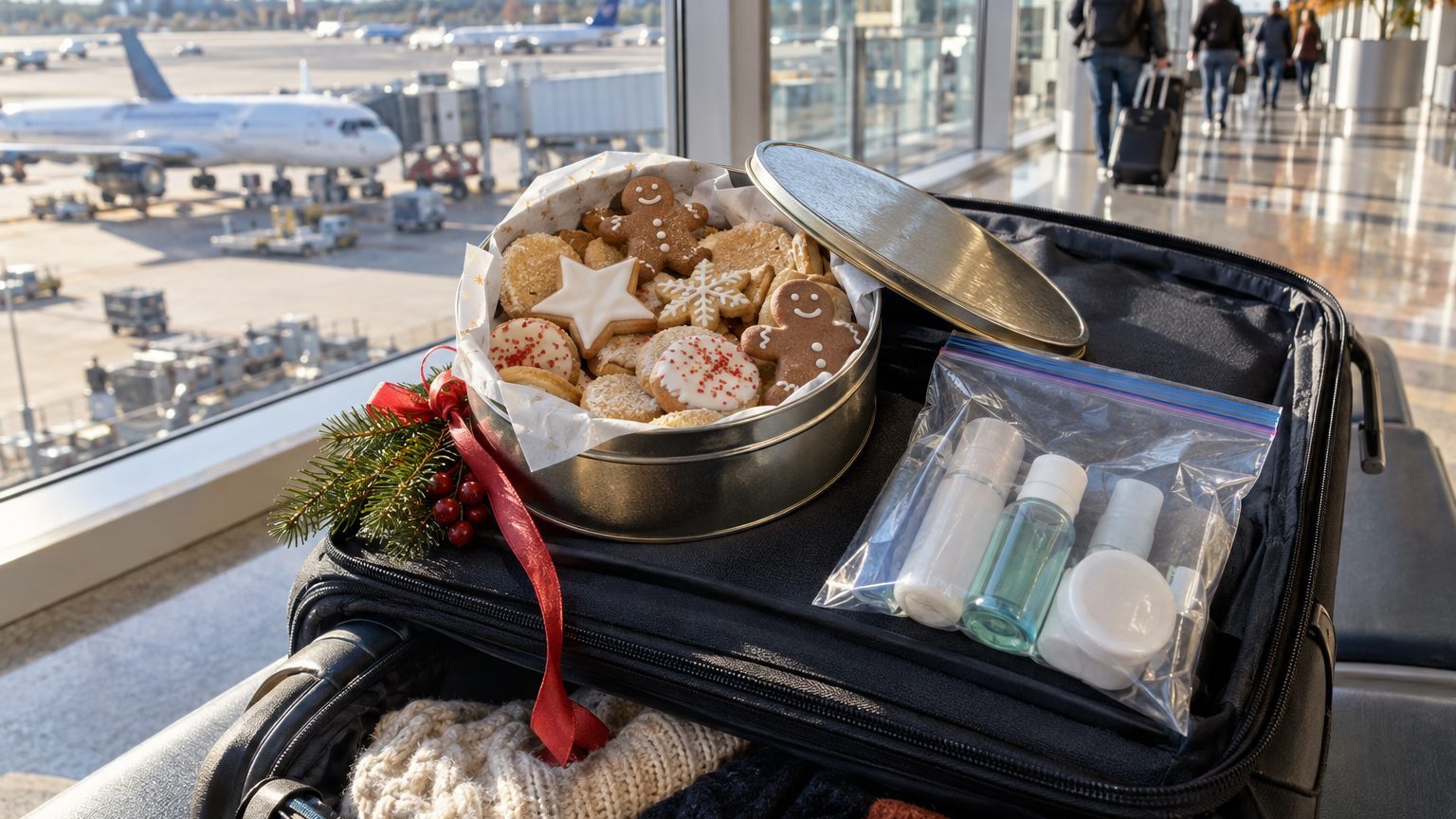
Yes. Cookies are allowed in both carry-on and checked bags. TSA treats them as solid food, and the agency’s own holiday cookie post says so. The gray zone is anything spreadable or wet, like thick frosting, cream cheese filling or dips. Those get judged like liquids and gels, and the officer at your lane has the final say. Pack the cookies in a sturdy airtight tin, keep it in your carry-on, and be ready to lift it out of the bag.
Can you bring baked goods through tsa
Homemade and store-bought cookies both pass. TSA says cakes, cookies, pies and other solids can go through the checkpoint in carry-on luggage. The only real limit is what fits in your bag and your airline’s weight rules.
Solid cookies vs. frosting, fillings and dips: what counts as a liquid or gel
TSA’s test is blunt. If you can spill it, spread it, spray it, pump it or pour it, and it’s larger than 3.4 ounces, it should go in a checked bag. Carry-on liquids, gels, creams and pastes must sit in a quart-sized bag, in containers of 3.4 ounces (100 milliliters) or less.
A sugar cookie with hardened royal icing is a solid. A tub of soft buttercream is a spread, so it belongs in checked luggage. Thick, soft frosting piled on a cookie sits in between, and it’s the item most likely to earn a second look.
Carry-on vs. checked bag: which is better for cookies
Carry-on wins for most travelers. The tin rides above the crush zone, and a delayed or lost suitcase can’t take your gifts with it. The cost is a possible request to take the tin out at screening.
Checked bags make sense for several tins that won’t fit in the cabin, but expect rough handling and less predictable hold temperatures. Fragile frosted cutouts belong in the cabin. Dense gingerbread or shortbread can survive the hold if the tin is rigid and packed tight.
What happens if a TSA officer wants a closer look at your tin
Officers can pull food for extra screening, and it’s usually routine. Keep it simple:
- Say plainly what it is: “Homemade cookies, nothing liquid inside. Happy to open it.”
- Remove the lid yourself and step back from the belt.
- Accept a swab or visual check without repacking in the lane. Close the tin and finish packing at the bench.
- If an item is refused, ask whether it can go in a checked bag, or eat it.
More tips for getting through TSA smoothly are worth a read before the busiest travel days.
How to pack cookies for a flight
Choose cookies that travel well (and ones to skip)
Dry, dense cookies survive best. Soft, wet or heavily decorated ones are the risk. The table below sorts common holiday treats by how they behave at the checkpoint and in the bag.
| Treat | TSA status in carry-on | Checked bag status | Packing tip or risk |
|---|---|---|---|
| Sugar cookies | Allowed, solid food | Allowed | Layer with parchment so icing and sprinkles don’t scuff. |
| Gingerbread | Allowed, solid food | Allowed | Sturdy, but thin arms and legs snap, so pack figures flat. |
| Shortbread | Allowed, solid food | Allowed | Crumbles if the tin has gaps, so fill every void. |
| Frosted cutouts | Allowed if the frosting is set hard; soft thick frosting may get questioned | Allowed | Let icing dry fully and pack apart from unfrosted cookies. |
| Thumbprints with jam | Usually fine as a baked cookie, but officer discretion applies | Allowed | Jam can smear. Separate layers with parchment. A loose jar of jam follows the liquid rule. |
| Fudge | Firm fudge is a solid; soft, spoonable fudge may be treated as a spread | Allowed | Heat softens it. Wrap in wax paper and keep it cool. |
Step-by-step packing: containers, layering and cushioning
Start with cookies that are completely cool and icing that has set. Then:
- Line a rigid tin or container with parchment.
- Stack cookies in tight layers, with parchment or wax paper between each one. Keep frosted cookies in their own layer or container.
- Fill every gap with crumpled parchment or tissue so nothing shifts.
- Seal the lid and slip the tin into a resealable bag.
- Put it at the top of your carry-on, where you can grab it without unpacking.
One TSA official suggests another method: stack the cookies, wrap the stack in plastic wrap, then slide it into an empty Pringles can. For checked bags, add bubble wrap around the tin.
How to keep cookies fresh and unbroken on a long travel day
Heat is the enemy of icing and fudge, so keep the tin in the cabin, away from sunny car dashboards and warm gate-area windows. An airtight lid matters more than the tin itself, because air turns crisp cookies soft and soft cookies hard. Keep dairy-topped treats cold until you leave.
Should you wrap the tin as a gift before the airport
Wait until you land. A wrapped box that has to be opened at screening won’t survive. A gift bag with a ribbon, or a tin with a loose bow, gets you the same look with less risk. The same logic applies to can you bring wrapped gifts on a plane: pack the paper separately and wrap on arrival.
Can you bring food through tsa
General rules for solid food in carry-on and checked bags
You may carry most foods through a TSA checkpoint, but you need to transport some items in checked baggage. Solids go in either bag. Anything spreadable, pourable or creamy over 3.4 ounces goes in checked luggage, where liquid size and quantity don’t matter, though overweight bags may carry additional fees. Dense food can also look odd on the X-ray, which is why a separate, easy-to-open container helps.
Holiday treats that get flagged: fudge, cheesecake, jams, eggnog and spreads
The usual suspects are the wet ones. Preserves, jams, jellies, eggnog and maple syrup must go in a checked bag if the container is over 3.4 ounces. Cream cheese spreads, cranberry sauce and gravy follow the same rule. Cheesecake bars and firm fudge are solid enough to pass, though they draw extra attention. A whole cheesecake follows the same logic as can you bring pie on a plane. Boozy treats such as rum cake or spiked eggnog add their own limits, covered in can you bring alcohol on a plane.
Can you bring Christmas cookies on international flights or to another country
Customs and agricultural rules for baked goods and homemade food
Leaving the US, TSA applies the same checkpoint rules. The catch is the country you land in, because its customs officers decide what enters. Some countries restrict homemade food, dairy or eggs, so check the destination’s customs page before you pack a gift tin.
Coming home, U.S. Customs and Border Protection lists bread, cookies, crackers, cakes, cereal and other baked and processed products as generally allowed. You still have to declare them: the declaration must cover all items carried in checked baggage, carry-on luggage or in a vehicle. Failure to declare food can bring fines of up to $10,000. Keep receipts and original packaging, since they help prove a food’s country of origin.
Domestic flights to Hawaii, Puerto Rico and other US territories
These are domestic flights, but agriculture inspections still apply. You must present all food, plants and other agricultural items to the USDA inspector at the airport before you leave Hawaii. The same applies leaving Puerto Rico or the U.S. Virgin Islands. Travel to the mainland from Puerto Rico or the U.S. Virgin Islands adds a pork rule: only baked goods containing pork that are commercially labeled, packaged and shelf-stable are allowed, so homemade ones with pork or lard stay behind. Declare your cookies at the inspection desk before you reach TSA.
How early should you pack cookies and how long do they stay fresh when traveling
Bake crisp cookies such as shortbread, gingerbread and sugar cutouts two or three days ahead, and pack them the night before. Plain homemade cookies keep for several days at room temperature in an airtight container, though flavor and texture peak much sooner. Cookies with dairy or egg frosting or filling should be refrigerated and eaten within a few days.
For a long trip, freeze the cookies and let them thaw in the sealed tin, which limits condensation. Cookie dough and cheesecake bars should travel cold, in a cooler packed with frozen ice packs (check the cooler against the liquid rule if it goes through the checkpoint).
How do you mail Christmas cookies instead of flying with them
Shipping beats flying when the trip involves a tight connection, a very long travel day, a Hawaii or territory departure, or several dozen delicate frosted cookies. Pack the tin the same way, then place it in a shipping box with at least an inch or two of padding on every side. Choose sturdy cookies, skip cream fillings, and ship early in the week.
Sending cookies from Hawaii is different. Agricultural items must be inspected by APHIS before you take your package to an airline cargo office, the post office or another courier.
Frequently Asked Questions
Can you bring cookie dough on a plane?
TSA doesn’t give a clear yes or no. Dough is soft and pliable, so an officer may treat it like a spread and limit it to 3.4 ounces in a carry-on. The safest route is frozen dough in a cooler in checked luggage. Don’t eat it raw.
Do cookies have to go in a clear bag at TSA?
No. The clear quart bag is for liquids, gels, creams and pastes, not solid cookies.
Can you take a gift tin of cookies to a different country?
TSA lets it leave the US. Whether it gets in depends on the destination’s customs rules, which often treat homemade food and dairy or egg ingredients more strictly. Commercially sealed cookies with an ingredient label are the lower-risk choice, and you should declare them on arrival.
Will TSA open my cookie tin?
Possibly. An opaque tin can’t be read at a glance on the X-ray, so officers may ask you to open it or swab it. Put it on top of your bag, lid easy to remove, and you’ll be through quickly.
Can you take cookies on a plane without a container?
Security allows it, but crumbs and crushed cookies are the likely result. Cookies that aren’t prepackaged should be wrapped or placed in a resealable bag or container with a secure lid.
Sources: aphis.usda.gov | govinfo.gov | tsa.gov