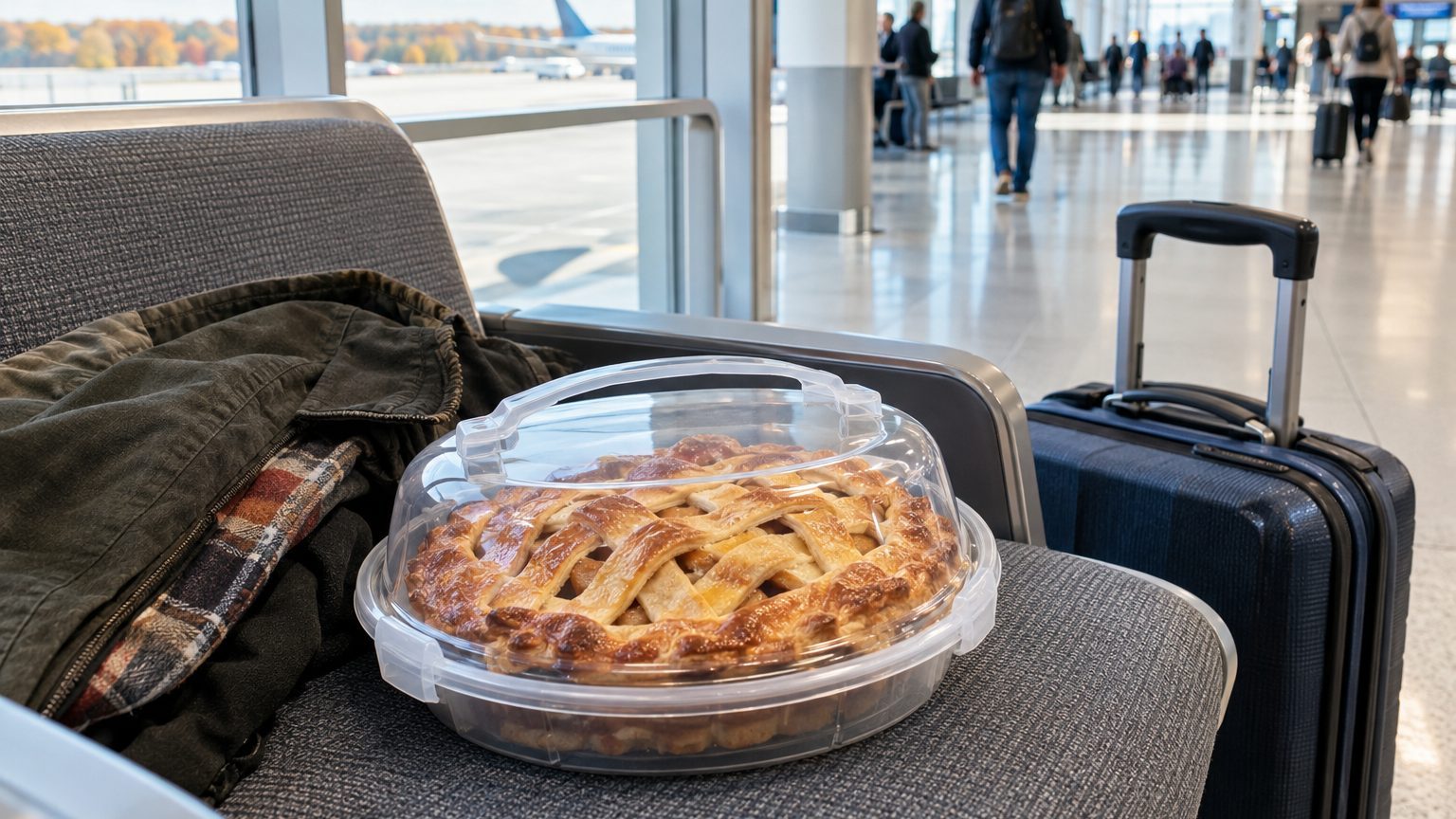
Yes.
TSA lists homemade and store-bought pies, cakes, cookies and brownies among the foods that can go through a checkpoint.
A pie is a solid, so it can ride in your carry-on or your checked bag. The one real risk is a filling loose enough to be treated like a spreadable. That risk is small and you can manage it.
Can you bring pie through TSA?
TSA’s food rule is short.
A solid item can go through a checkpoint. If you can spill it, spread it, spray it, pump it or pour it, and it’s larger than 3.4 ounces, it belongs in a checked bag.
Pumpkin, apple, pecan and cherry pies sit on the solid side of that line. The agency has repeated this guidance in its Thanksgiving press releases for years. The 2024 version names pies directly, and so does its general food guidance.
Carry-on and checked bags are both allowed, and quantity isn’t capped. Fox News, summarizing TSA guidance, reports that
cakes, cookies, pies, meats, casseroles and other solids can travel in carry-on luggage in unlimited quantities during holiday travels.
Your real limit is space.
Some airlines count a pie box as a personal item
, so a pie box plus a roller bag plus a purse can put you over your airline’s allowance at the gate.
Expect a little extra attention. Dense baked goods can hide detail on an X-ray image, so officers may take a second look.
Don’t be surprised if an officer swabs your cake or pie to check for traces of explosives.
That is routine and takes a minute. One travel writer who flew out of Michigan with a cherry crumb pie
reported that jokes about “confiscating” it were the only extra security she met.
The fine print matters in one case. Some pies have fillings that are barely set, such as a custard pie that hasn’t firmed up or a fruit pie with a gelatinous, sloshy center. One consumer FAQ notes that
an officer might treat a very runny filling as a “gel” and apply the 3-1-1 liquids rule.
That is a caution from a secondary source. It is not a published TSA test. It does match TSA’s own disclaimer:
“The final decision rests with the TSA officer on whether an item is allowed through the checkpoint.”
A pie that has chilled overnight and holds a clean slice is very unlikely to be a problem. A pie that jiggles when you carry it is a candidate for the checked bag.
Can you bring homemade food on a plane?
Homemade food gets the same treatment as store-bought. TSA doesn’t care who cooked it, only what state it’s in. Its Thanksgiving list covers a lot of the holiday table in the carry-on category:
frozen, cooked or uncooked meats such as turkey, ham and steak, plus cooked or uncooked stuffing in a box or bag.
Solid casseroles are on the list too, as is
mac ‘n cheese, whether cooked in a pan or packed as ingredients to cook at your destination.
The trouble starts with the sides.
Cranberry sauce, homemade or canned, is spreadable, so TSA says to check it. Gravy, homemade or from a jar or can, goes in the checked bag too.
Jams, jellies and preserves follow the same rule. Canned goods packed in liquid fail the carry-on test as well. TSA’s food specialist put the test this way:
if you can shake the can and hear liquid inside, it goes in the checked bag.
Pumpkin pie filling in a can falls into that group, but the baked pie does not.
If you want a spreadable item in your carry-on anyway, freeze it. TSA says
frozen spreadable foods and ice packs are allowed in carry-on and checked bags, and frozen items may exceed 3.4 oz in a carry-on as long as they’re completely frozen solid at screening.
The words “solid at screening” carry the weight there. A container of gravy that has started to slush at the edges won’t pass. Plan for the airport’s timeline, not your freezer’s.
A few categories sit outside the food rule. If your holiday dish calls for a bottle of bourbon or rum, that bottle follows liquor rules, not baked-goods rules. The details on volume and proof are covered in can you bring alcohol on a plane. TSA has also stated that
drinks above 70% alcohol (140 proof) are forbidden in both carry-on and checked baggage.
A fully baked bourbon pecan pie is just a pie. The bottle you bought to make it is a different matter.
One more distinction: domestic and international. Everything above describes TSA screening for flights within the United States, and for departures from US airports. An international trip adds a second layer, because the destination country’s customs rules decide whether you can bring food in at all. Baked goods are usually the easiest category, but fillings with fresh fruit, eggs or dairy get more scrutiny in some countries. Check the destination’s agriculture or customs site before you pack a pie for a flight abroad.
How to bring a pie on a plane
Start with the container, since the rest of the trip depends on it. A rigid pie carrier, a sturdy bakery box or a lidded plastic container keeps the crust from cracking and makes inspection easy. TSA recommends
placing food items in a clear plastic bag or other container when packing at home, then removing them from your carry-on and putting them in a bin for screening.
A clear lid lets an officer see the pie without opening it. That can save you the awkward moment of a stranger lifting your crust in a crowded security lane.
Carry-on: the better default
For one or two pies, the carry-on is the safer choice because you control how it’s handled. A travel writer for Fox News calls the carry-on the preferred method. Pack the pie on top of your bag or carry it separately, so it can come out quickly at the belt. Put it in its own bin if the officer asks. Then choose where it goes on the plane: under the seat in front of you, or flat in the overhead bin with nothing stacked on top. Standing a pie carrier on its edge in a packed bin is how a lattice top turns into rubble.
Gift-wrapped boxes are a special case. A pie you’ve wrapped in paper and ribbon for a host may be opened by an officer who needs to see inside, and that’s a fair price for the extra screening. A reusable box with a loose bow, or a bag with a folded top, handles inspection better. The same logic applies to other presents, which can you bring wrapped gifts on a plane covers in more depth.
Checked bag: cushion it like glass
Checking a pie works, but it takes more padding. The same Fox News piece describes the approach:
wrap the pie in plastic, put it in a sturdy cardboard box, then cushion it with a blanket or bubble wrap.
Put the box in the middle of the suitcase, surrounded by soft clothes, and keep it away from the edges, where baggage handlers’ hands and conveyor belts do their worst. Never put heavy shoes or toiletry bags on top. A checked bag also goes unrefrigerated for hours, so this suits a sturdy fruit pie better than a cream pie. For more on cushioning fragile gifts, see how to pack gifts in a suitcase.
Keeping a pie cool is the other half of packing. Fruit pies handle a few hours at room temperature without trouble. Pies with custard, cream, pecan or pumpkin filling are a different matter. Food safety guidance for the holidays treats cooked, egg-based and dairy-based foods as perishable, so plan on chilling those pies overnight and traveling with them cold. If you use ice packs,
they must be frozen solid, not melted, when they go through security screening.
Gel packs that arrive at the checkpoint half-thawed can be refused, and then you have a warm pie and a bin full of water.
Build in time. Holiday checkpoints are slow, and food that needs extra screening adds a couple of minutes to your own turn. Arrive earlier than usual in Thanksgiving week and during the busy stretch before Christmas. TSA also keeps a “What can I bring?” tool on its website for any item you’re unsure about.
You type in the item and find out whether it goes through a checkpoint or in a checked bag.
Typing “pie” costs ten seconds, and the answer comes from the agency that makes the call at the airport.
A last practical tip: bring the cutting tools with the thought of the checkpoint in mind. A long or sharp knife for slicing is prohibited in a carry-on, even though the pie is fine. Pack the knife in your checked bag, or buy a disposable cutter once you land.
Sources : tsa.gov