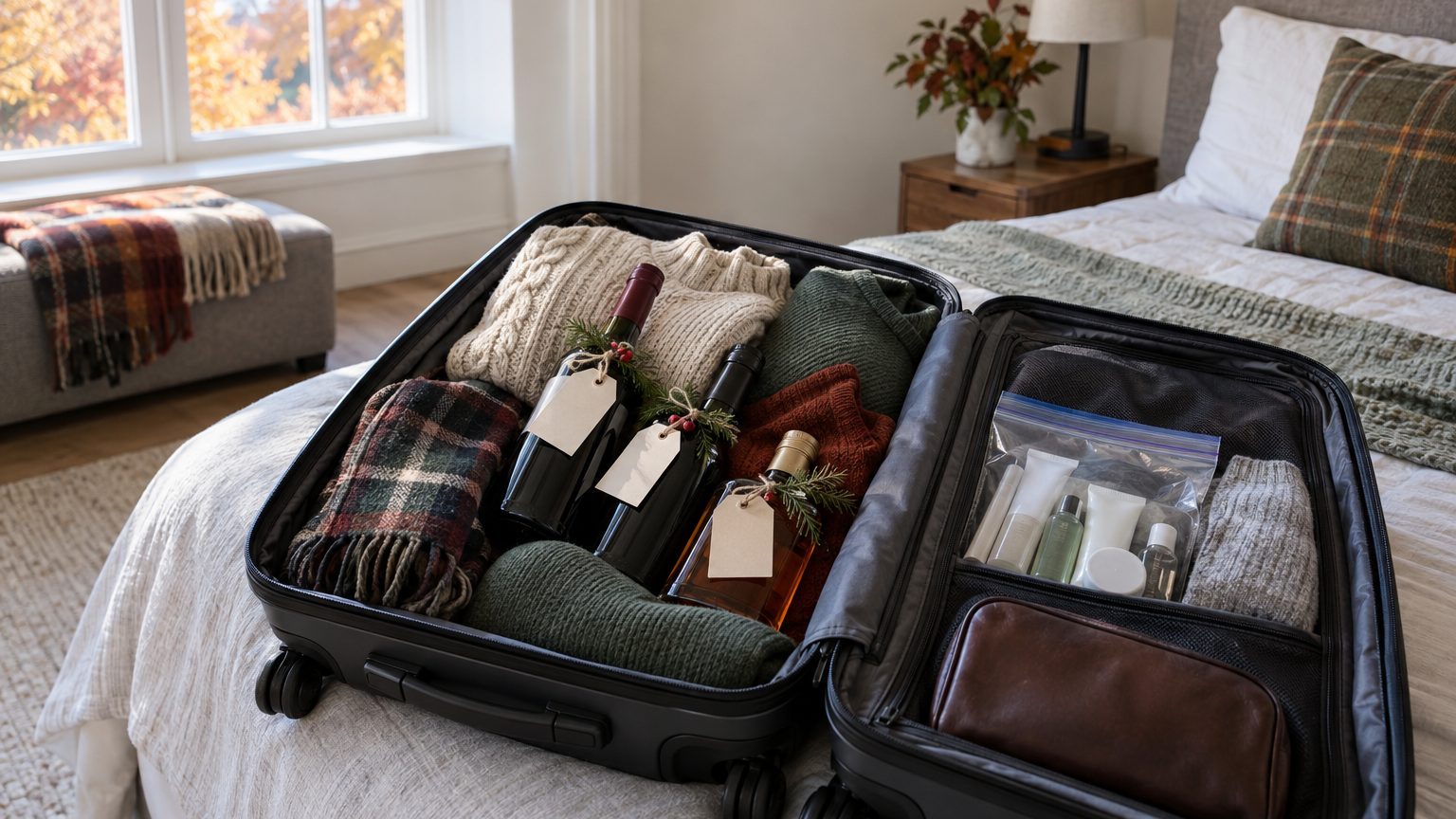
Yes, with limits. A full-size bottle of wine, whiskey or bourbon belongs in your checked bag. In your carry-on, only containers of 3.4 ounces or less are allowed, and they must fit in one quart-sized bag. Anything stronger than 140 proof (70% alcohol by volume) can’t fly in either bag.
FAA regulations prohibit passengers from drinking alcohol on board unless the air carrier serves it
, so the bottle you pack stays closed until you land.
That covers the basics for a holiday gift bottle headed to a Thanksgiving table or a Christmas party. The details change depending on strength, bag and destination, so they’re worth sorting out before you pack.
Alcohol in checked luggage
The checked-bag rules work in three tiers, and the tier depends on the alcohol percentage printed on the label. The FAA’s PackSafe guidance and the underlying hazmat regulation (49 CFR 175.10) set the thresholds. The TSA enforces them at the airport.
Beer, wine and most ciders sit in the lowest tier.
Alcoholic beverages with 24% alcohol or less are not subject to limitations in checked bags.
The only ceiling left is your airline’s weight limit, which is commonly 50 pounds for a standard checked bag. A 750 ml bottle of wine weighs roughly 2.5 to 3 pounds with its glass, so a case of twelve adds roughly 30 to 36 pounds. That is enough to turn a light suitcase into an overweight one.
Spirits and liqueurs above 24% alcohol fall in the middle tier (many fortified wines are 24% or less and stay in the lowest tier).
Drinks with more than 24% but not more than 70% alcohol by volume must be in unopened retail packaging, with a limit of 5 liters per packaging and 5 liters total per passenger.
Five liters is about
six regular 750 ml bottles (4.5 liters), or two large 1.75-liter bottles (3.5 liters)
, with a little room to spare. The cap is per person, so two adults checking bags can carry twice as much. It is not a per-bag limit. Splitting a haul across three suitcases won’t raise it.
The words “unopened retail packaging” matter more than most travelers realize. The half-finished bottle of bourbon from the kitchen cabinet doesn’t qualify. Neither does a flask you’ve filled yourself or a bottle decanted into something prettier. If it’s a gift, the factory seal and original label are what let it through.
The top tier is a hard no.
Anything above 70% alcohol by volume, including grain alcohol and 151-proof rum, is covered by the FAA hazmat rules in 49 CFR 175.10
and not allowed in carry-on or checked bags. A 151-proof rum souvenir from a Caribbean vacation is the classic casualty. Check the proof on the label before it goes in the suitcase, because a bottle that gets flagged is usually surrendered on the spot.
One nuance: the federal rules are a floor, not the full picture.
Some items allowed under DOT regulations may at times be prohibited or limited in the cabin by TSA security rules
, and airlines can add their own conditions. If you’re flying a small regional carrier or booking a basic economy fare with unusual baggage terms, a two-minute look at the airline’s baggage page is cheap insurance.
TSA alcohol rules for carry-on bags
The cabin is where many bottles get stopped. Alcohol is treated like any other liquid at the checkpoint, so the 3-1-1 rule applies in full:
containers of 3.4 ounces or less that fit comfortably in one quart-sized, clear, zip-top bag
, one bag per passenger. The proof doesn’t change that. A 3-ounce mini of vodka and a 3-ounce mini of cordial are treated the same way, and both share space with your toiletries.
That arithmetic gets tight fast. A quart bag holds a handful of airline-size minis, but it also needs to hold your travel-size shampoo, toothpaste and contact solution. If the minis are the gift, expect to leave something else behind or move it to your checked bag.
A standard bottle of wine is out of the question at the checkpoint.
A normal full-size wine bottle is too large for the ordinary carry-on liquids allowance, so pack it in checked luggage or buy it after security.
The after-security route is a reasonable option if you’re leaving from a major airport with a well-stocked shop. But check the connecting airport before you rely on it, because
a duty-free purchase doesn’t guarantee it will clear a later connecting checkpoint
.
International itineraries add a wrinkle. If you buy alcohol at a duty-free shop and are on an international flight with a U.S. connection,
you can carry up to five liters in a secure tamper-evident bag with the receipt
. The bag has to stay sealed until your final destination. Open it in the terminal during a layover and the bottle becomes a problem at the next screening.
Gift wrap deserves its own warning. A boxed bottle or a bottle in a pretty sleeve is easy to inspect. A bottle taped inside layered paper is not, and officers may need to open it. The same logic applies to every present in a bag, which is covered in the guide on can you bring wrapped gifts on a plane. For alcohol, the practical move is to carry the wrapping supplies and dress the bottle at your destination.
How to pack wine in a suitcase
Glass doesn’t fail because of the plane. It fails because a bag gets thrown onto a belt, dropped from a cart or squeezed under a stack of luggage. The goal is to keep the bottle from touching anything hard, including the suitcase wall.
Start with the bag itself. A hard-shell case gives the most protection, though a well-packed soft-sided bag works too. Place the bottle in the middle of the suitcase, not along an edge or corner, so a layer of clothing sits between the glass and the outer shell on every side. Sweaters, jeans and bath towels do this job better than T-shirts.
Put each bottle in its own sealed plastic bag, then wrap it in soft clothing. Cabin pressure can nudge corks, and a leak is a disaster for everything else in the bag. The plastic bag turns a spill into a mild annoyance. Stack nothing heavy on top. If you’re carrying two or three bottles, keep them apart with clothing instead of letting them clink in a row.
Purpose-made wine bags and foam-lined shippers are widely sold and well suited to the job, particularly if you’re bringing home bottles from a winery trip. If the gift has its own sturdy box, keep it in the box and add padding around the box. The full routine for odd-shaped presents is in the guide on how to pack gifts in a suitcase.
Food gifts follow a different set of rules from drinks. A holiday dessert faces its own checkpoint questions, covered in the piece on can you bring pie on a plane. If you’re bringing both a bottle and a dessert, pack the bottle in the checked bag and the dessert in the carry-on.
Customs, state laws and the trip home
The TSA and FAA rules govern the flight. Customs governs what happens when you land from abroad. For an international return,
CBP allows each traveler aged 21 or older to bring in 1 liter of alcoholic beverages duty-free for personal use, provided it doesn’t violate the laws of the arrival state
.
One liter is only the free portion.
You can bring more, but you’ll need to declare the extra bottles and pay federal duty and IRS tax on each additional liter.
Declare everything, including bottles bought at airport duty-free shops.
Travelers must declare every bottle, including products bought at airport duty-free stores.
The declaration doesn’t mean you owe money. The first liter still passes without duty.
Age matters here too.
Travelers under 21 cannot import alcohol into the United States, even when it belongs to another person.
A college student carrying a bottle for a parent is a common version of this mistake. State laws add another layer, since
state law can be stricter than federal law, and CBP enforces the arriving state’s alcohol limit
. California’s alcohol regulator, for example, requires that beverages brought in from abroad accompany the returning traveler and not be shipped later.
For domestic Thanksgiving or Christmas flights, the customs rules above don’t apply, but the TSA, FAA and airline rules still do. The TSA’s MyTSA app has a “What can I bring?” search, and typing in the bottle’s category takes seconds. Airline baggage pages are worth a look for weight and fee limits, since a heavy case of wine can turn into a surprise charge at the counter.
Sources : abc.ca.gov | faa.gov | faa.gov