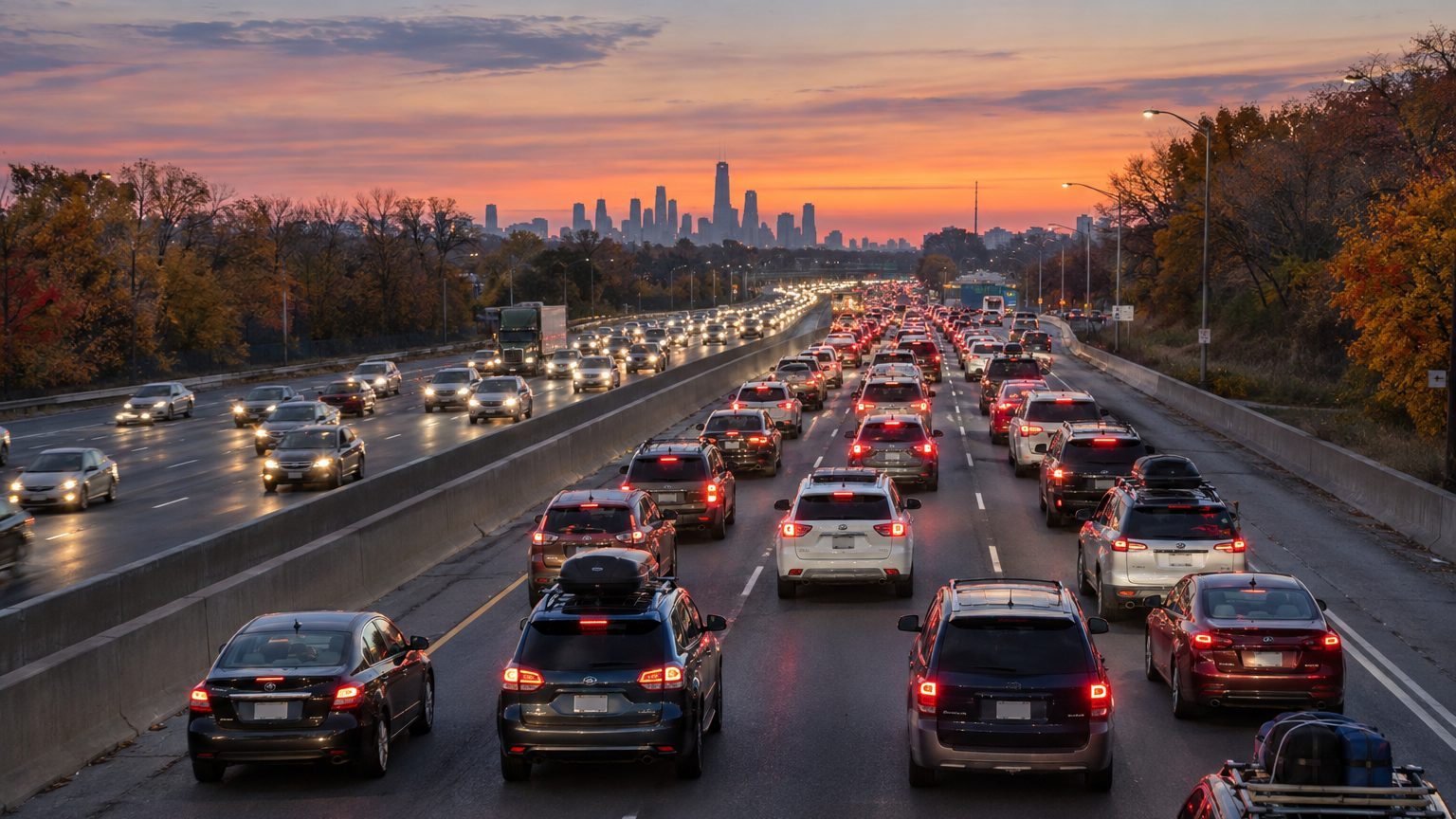
The worst times to drive for Thanksgiving are the Tuesday and Wednesday afternoons before the holiday: noon to 9 p.m. on Tuesday and about 11 a.m. to 8 p.m. on Wednesday. Those windows come from the most recent AAA forecast, built with traffic analytics from INRIX. The 2026 calendar has the same weekday pattern, so they map to Tuesday, November 24, and Wednesday, November 25. AAA usually publishes its new forecast in mid-November (the 2025 edition came out on November 17), so check it before you finalize your departure.
The scale explains the traffic. For 2025, AAA projected
at least 73 million Americans traveling by car, almost 90% of all holiday travelers
. That is more than the combined population of California and Texas, all trying to use the same interstates in the same few days.
Worst time to drive Thanksgiving week
The pain isn’t spread evenly. It piles up in a few predictable windows, and knowing them is most of the battle.
Before the holiday, the damage is concentrated on two afternoons. AAA’s forecast put the worst conditions at
noon to 9 p.m. on Tuesday and 11 a.m. to 8 p.m. on Wednesday
. INRIX describes
Tuesday and Wednesday afternoon as the most congested times for drivers in major metro areas
. AAA does not rank the two days, and some corridors peak on Tuesday rather than Wednesday, so avoid both afternoons if you can.
How bad is bad? The numbers from the 2025 forecast for individual corridors are blunt. In California,
the Los Angeles to Bakersfield drive on I-5 North was projected to take 147% longer on Wednesday at 7:45 p.m.
The San Francisco to Santa Rosa run on US-101 North was projected at
114% longer on Tuesday at 7:15 p.m.
In that Los Angeles example, AAA and INRIX projected a drive of about 4 hours 10 minutes, more than double the normal time.
Not every route suffers the same way. On Highway 26 between Portland and Bend, AAA Oregon/Idaho projected increases of only about 10% for the worst Tuesday afternoon eastbound, and
about 12% for the late-Monday return
. That corridor was much gentler than the big-city freeways, but its worst times were still in the afternoon.
The return trip is its own problem, and it lasts longer than the outbound rush. The post-holiday worst windows in the 2025 forecast were:
- Friday from 1 p.m. to 7 p.m.
- Saturday from 1 p.m. to 8 p.m.
- Sunday from 11 a.m. to 8 p.m.
- Monday from noon to 8 p.m.
Sunday stands out. AAA and INRIX flagged it for
heavy traffic most of the day
, which makes it the return day to avoid if your schedule allows. If Sunday is your only option, the same data says the morning before 11 a.m. is your best shot.
One more risk deserves a mention. The night before Thanksgiving, often nicknamed Blackout Wednesday, is widely described as a high-risk night for impaired driving because so many people are out meeting friends and family. Even if the traffic has thinned by 9 p.m., that is a good reason to be off the road or to extra-carefully watch the vehicles around you.
Best time to drive for Thanksgiving
Start with the easy win. Thanksgiving Day itself is the lightest day on the roads. AAA reports that
Thanksgiving Day is the easiest day to drive, with minimal delays expected
. The reason is simple: by Thursday morning, nearly everyone has already arrived, and the cooks are in the kitchen. If your host’s table is within a few hours’ drive, a Thursday morning departure beats almost any other plan, provided you can arrive for the meal.
If you can’t wait until Thursday, the general rule is to get ahead of the afternoon wave. The best departure times in the forecast were
Tuesday before noon, Wednesday before 11 a.m., or Thanksgiving Day
. These windows are narrow. A 10:45 a.m. departure on Wednesday is a good plan. A 12:15 p.m. departure is walking into the peak.
Coming home, the pattern is similar but with one twist.
After Thanksgiving, the best times to travel are Friday or Sunday before 11 a.m., Saturday before 10 a.m., or Monday after 8 p.m.
Notice that Monday is the exception: since the afternoon is clogged with people who stayed one more day, the sweet spot flips to late evening, when
conditions improve after 8 p.m.
That suits anyone who can work from home Tuesday morning or who doesn’t mind a late arrival.
A few other decisions shift the odds in your favor. None of these is in the forecast tables, but they follow the logic of the data:
- Leave Monday or Tuesday morning if your employer allows it. Shifting earlier keeps you out of the Wednesday afternoon peak.
- Break up a long drive. A route of eight hours or more can start the night before, with an overnight stop, so you clear the metro areas before the afternoon crush.
- Check the weather as well as the traffic. AAA’s own caveat is that construction, crashes, or severe weather can change travel times, and a storm system can undo the best timing.
For broader advice on preparing for the trip, see our thanksgiving travel tips. And if you’re weighing the car against a plane, the best day to fly for thanksgiving follows a slightly different calendar, since airports peak on different days than highways do. Sunday after the holiday is a heavy return day for both, which is an odd point of agreement.
Thanksgiving road trip ideas
Thanksgiving isn’t only about reaching a relative’s house. For a lot of drivers, the long weekend is the one chance in fall to take a real road trip, and the traffic data can shape a better itinerary than an arbitrary route.
The simplest idea is the reverse commute. Much Thanksgiving congestion runs out of big cities before the holiday and back into them afterward. If your route runs the opposite way, you may be going against the heaviest flow. That doesn’t make you immune to delays, particularly on Tuesday and Wednesday, but a trip that begins Thursday morning usually meets less resistance than one aimed at a major airport corridor.
Another approach is a loop that uses Friday for the scenic part. Friday’s worst window starts at 1 p.m., and the best time to be on the road is before 11 a.m. Pick a destination within about two hours, a state park or a small downtown with a holiday market, and be on the road before the afternoon rush starts. You can have lunch, take a walk, and either stay put through the evening or drive back after 7 p.m., when the worst Friday window has ended. (Parks and shops often have reduced hours on Thanksgiving week, so check them before you go.)
If you have the full five days, consider an out-and-back with a midweek anchor. Drive out on Tuesday before noon, stay at one base through Thursday, and head home Saturday before 10 a.m. or Monday night after 8 p.m. You avoid three of the week’s heaviest windows (Tuesday afternoon, Wednesday afternoon and Sunday), and you get a real stay instead of a day trip.
Some drivers are better off not driving at all. Corridors with frequent rail service, particularly in the Northeast, can sidestep much of the highway gridlock. Our guide to train travel thanksgiving holiday explains how booking, crowds and schedules work on that side, which is useful if the numbers above make your route look grim.
Whichever plan you choose, the forecast is a guide and not a promise. AAA’s tables describe typical congestion across the country, not your specific interstate on your specific afternoon. A good habit is to check live traffic the evening before and again before you leave, then move your departure up by an hour if the app shows red. Leaving at 9 a.m. instead of 10 costs you an hour of sleep. Leaving at noon instead of 10 a.m. on the Wednesday before Thanksgiving can cost you hours of your trip.
One last point on timing: the numbers above describe the national pattern, and some cities buck it. In the 2020 AAA forecast, Washington, D.C. was the lone major metro where the worst day was Friday, with peak congestion at 11:45 a.m., and every other major city peaked on Wednesday. If you live in a market with unusual commuting or shopping patterns, local traffic data deserves a look alongside the national one.
Sources : npr.org | ace.aaa.com | blacklane.com