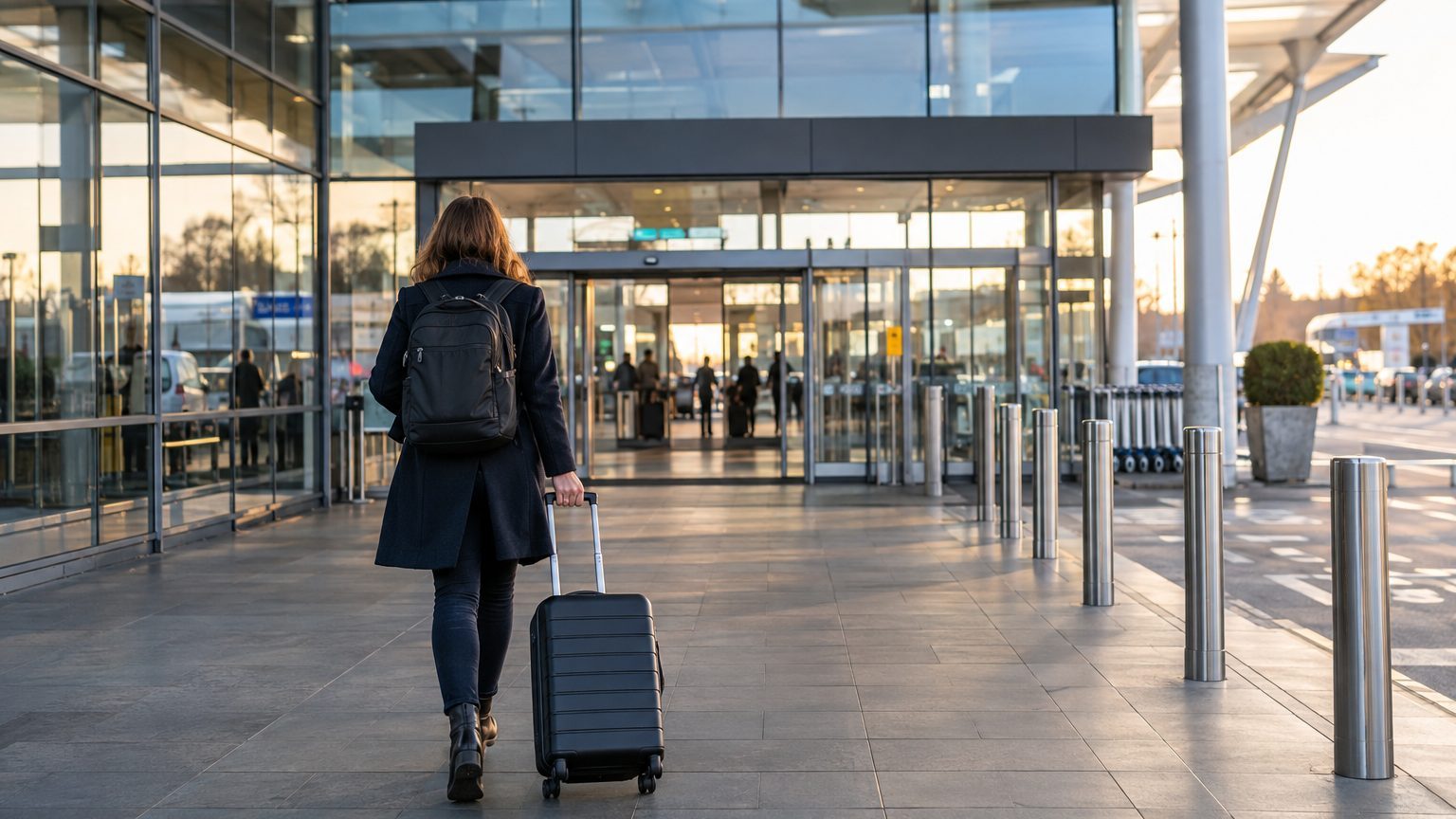
For a domestic flight, the TSA recommends arriving at least two hours before departure. Before the November rush, that number works better as a floor than a target. Add time if you’re checking a bag, flying out of a big hub, or leaving on one of the holiday peak days.
The Sunday after Thanksgiving makes the standard rule look optimistic.
- The TSA’s two-hour recommendation covers only part of the trip, since drive, bag drop and walk time come on top.
- A checked bag at a large hub needs two to two and a half hours, while carry-on with PreCheck can work in 60 to 75 minutes.
- Thanksgiving-week flights at big hubs call for about three hours with a checked bag and roughly 90 minutes carry-on with PreCheck.
What the two-hour rule is made of
The two hours are a bundle of smaller tasks. One breakdown puts the drive at 15 to 90 minutes, bag drop at 0 to 60, and TSA screening at 5 to 45 minutes, depending on the airport, the hour and your PreCheck status. Add the walk to the gate, and you can see how a “relaxed” two hours disappears.
Airlines also set hard cutoffs. United, American and Delta close check-in for domestic flights 30 to 45 minutes before departure, and boarding typically starts 20 to 30 minutes before takeoff. Whatever buffer you build has to cover those deadlines, not just the security line.
Your luggage changes the math more than anything else. With a checked bag at a large airport and a standard security lane, two to two and a half hours is the realistic range. Carry-on only, with PreCheck and some familiarity with the terminal, trims it to 60 to 75 minutes. A small regional airport can go lower still: with online check-in, no bag, and PreCheck or CLEAR, curb to gate can take as little as 20 minutes. Treat that as a best case. Nobody should plan a trip around it.
PreCheck is where most travelers overestimate the savings. Membership could shave minutes or an hour, though most passengers already wait 10 minutes or less. At large hubs like Atlanta or LAX, one guide suggests 75 to 90 minutes with PreCheck or CLEAR, against two hours without.
PreCheck shortens the security line, not the drive, the bag drop or the walk.
Why November breaks the usual math
Thanksgiving falls on November 26 this year, and the numbers around it are lopsided. On Sunday, November 30, 2025, TSA screened 3,134,613 people, the busiest day in the agency’s history. That is roughly the population of Iowa, pushed through checkpoints in 24 hours. Thanksgiving Day itself looked nothing like it, with 1,559,165 people screened, against 2,753,036 the day before. Half the crowd, almost exactly.
For 2026, the same pattern should hold. Wednesday, November 25 is the heaviest departure day, with the Tuesday before close behind, and the return crush lands on Sunday, November 29 and Monday, November 30. Federal forecasts tend to arrive late: TSA’s 2025 forecast came out on November 21 and AAA’s on November 17. Waiting for them means planning with almost no lead time.
On those days, add an hour at a big hub.
That advice comes from travel experts who suggest about an extra hour at busy hubs during the Thanksgiving peak, to cover longer checkpoint lines, fuller parking and heavier roads near the terminal. Los Angeles airport officials have given similar advice for busy periods, telling travelers to add at least 30 minutes to their regular routine. Do the arithmetic and a checked bag at a large hub lands around three hours (one guide lists 150 to 180 minutes for holiday travel at a large hub with a checked bag). Carry-on plus PreCheck sits closer to 90 minutes, perhaps a bit more.
Time of day matters too. Early-morning flights tend to have the shortest lines, but they come with their own tax: a 6 a.m. departure means being at the airport by 4 a.m. Thanksgiving Day and the Friday after are the calmest days to fly, if your plans can bend that far.
Small moves that buy back time
Start with the cheapest fixes. Check in online, travel carry-on only if the trip allows it, and download your boarding pass before leaving home. Every one of those steps removes a queue from your morning. Skipping the bag-drop line is worth more than most people expect, because it is the one wait that grows with the holiday and has nothing to do with security.
Parking is the quiet saboteur. Off-site lots, shuttles and full garages can eat 20 or 30 minutes before you even see a terminal door, and none of that shows up in the TSA’s two-hour guidance. Check your airport’s website or app for live wait times and parking status. LAX, for one, has used an automated account that posts TSA wait times, parking and traffic updates every 15 to 30 minutes. An unfamiliar airport adds 15 to 20 minutes for navigation and wayfinding.
Check your ID before the rush, too. A REAL ID-compliant license or a passport has been required at checkpoints since May 7, 2025, and a drawer-bottom discovery the night before a Tuesday departure is a bad time to find yours isn’t compliant. Not sure about your state’s license? Look it up on TSA.gov, or pack the passport.
Some travelers need more cushion than any chart gives. For a battery-powered wheelchair, the Department of Transportation recommends arriving at least one hour earlier than the airline’s standard check-in time, since attendants are in short supply on busy days. Families with young children and anyone requesting assistance should add similar time, and November is the month to be generous with it.
Sources : tsalinecheck.com | cluballiance.aaa.com