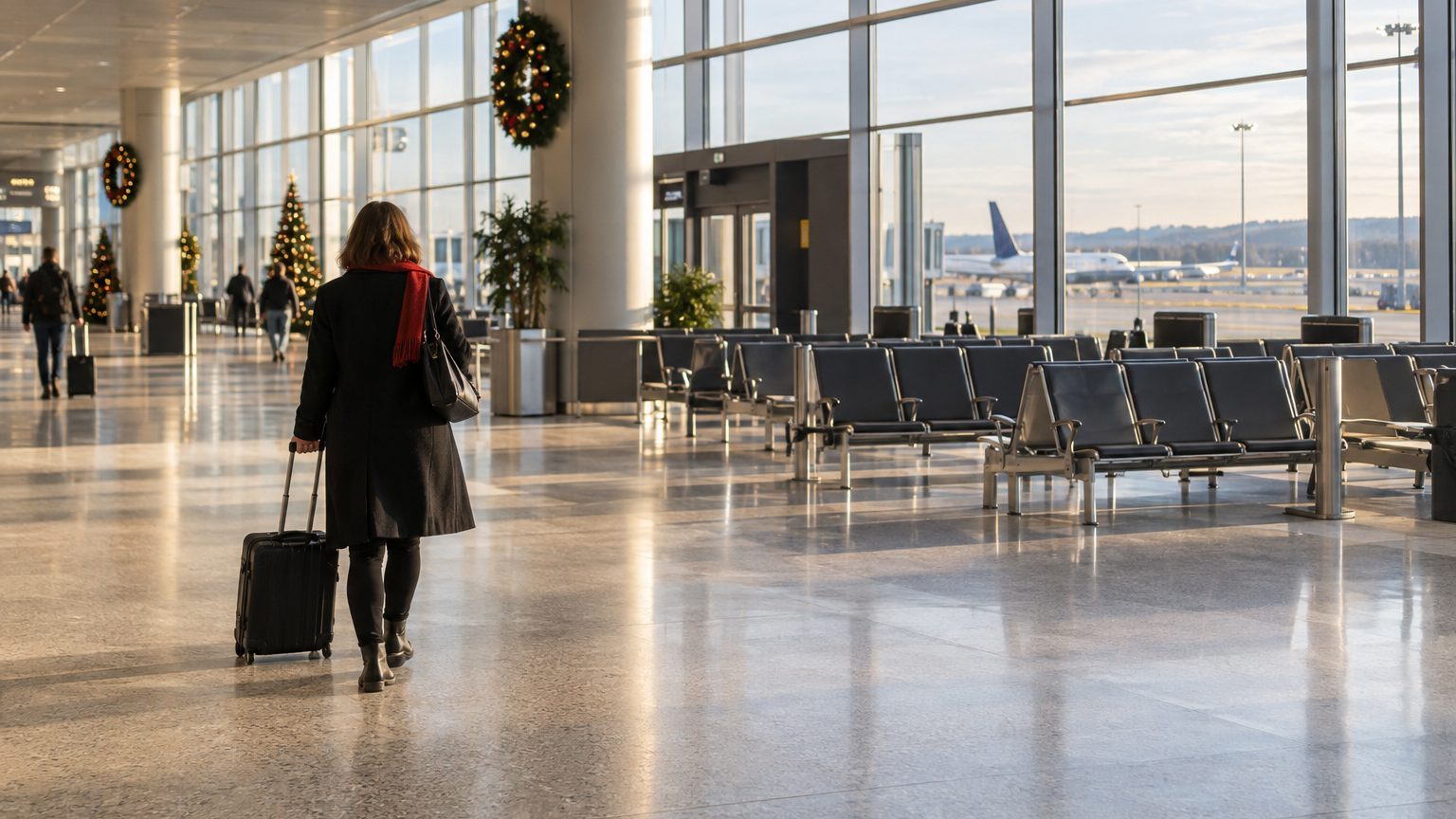
Christmas Eve is usually one of the cheapest days of the season to fly, and one of the calmer ones at the airport. In 2026 the 24th lands on a Thursday, and a major online travel agency’s holiday data names it the cheapest departure day for Christmas. The cheapest return is the following Monday, Dec. 28. The catch is that “cheaper” does not mean “cheap.” Fares are still running above normal, weather can wreck a travel day, and an early-morning departure can feel nothing like the quiet you were promised.
Why are Christmas Eve flights cheaper
Airlines price by demand, and demand on Dec. 24 drops off a cliff. Families want to be at the destination before the 24th, not in transit on it. Travelers who are flexible, remote, or simply not celebrating fill the gap, and there are not enough of them to keep fares high.
The size of the discount depends on whom you ask and which year you measure. A 2024 holiday outlook put the Christmas Eve saving at 26%, about $100 per ticket. An analysis of more than 40,000 domestic itineraries for 2025 found Christmas Eve fares still ran about 75% above a normal-day baseline. That sounds grim until you see the neighbors: Dec. 23 sat around 107% above baseline, and the Saturday before Christmas hit roughly $905 one way. Christmas Day itself, at about 27% above baseline, was the real bargain of that week.
International routes show the gap more sharply. Recent booking data shows that a flight on Dec. 18 costs about 27% more than the same international route on Dec. 24 or 25. For a family of four, that is the difference between a manageable ticket bill and a painful one.
Context matters this year. Holiday fares are rising: Expedia’s 2026 holiday outlook puts average ticket prices up 15% for domestic trips and 20% for international trips versus 2025. Federal price data cited in a recent report shows airline fares up 22.4% between September 2025 and September 2026. A Christmas Eve discount applies to a higher starting point, so expect savings relative to the surrounding days, not relative to last spring.
Time of day also moves the price. Evening departures on the 24th tend to cost less than morning or afternoon ones, and you still wake up at your destination on Christmas morning. Red-eyes and dawn flights are generally cheaper than flights in prime hours. Google’s 2025 holiday flight data adds two more levers: Monday-to-Wednesday departures ran about 13% cheaper than weekend ones, and adding a layover saved about 22% on average versus nonstop. A layover on Christmas Eve is a gamble, though (more on that below).
Timing of purchase matters as much as timing of travel. Google Flights data puts the lowest Christmas fares around 56 days before departure, with good deals in the 33-to-67-day window, and prices tend to climb as takeoff approaches. Counting from Dec. 24, the 56-day mark has already passed, but you are still inside the 33-to-67-day window for the next few weeks. Waiting for a last-minute drop is a losing strategy at Christmas. For a comparison across the whole holiday calendar, see our guide to the best day to travel for christmas.
Flying on Christmas Eve
Fewer travelers does not mean fewer flights, and that distinction shapes the day. Airlines keep schedules close to normal. One large U.S. carrier said that in 2025 it expected to operate about 6,400 flights on Dec. 24, carrying almost 700,000 customers, against roughly 6,600 flights and more than 675,000 customers the day before. Passenger counts stayed high because the airline ran nearly the same number of flights as on a peak day. Do not count on empty planes.
The morning wave is the exception. Early flights on the 24th can still sell out because they are the last realistic chance to reach family before the evening. Midday and late-evening departures tend to be lighter. If your plans are flexible, the evening flight wins on both price and crowding. The risk is that it leaves little buffer: a cancellation at 7 p.m. on Dec. 24 can mean a seat on Christmas Day at best, since rebooking options shrink fast when every flight out is already carrying its own load.
The late-day flight also has a weather problem. Dec. 24 has been a bad day for storms in recent years. In 2025, a Pacific storm hit California on Christmas Eve, and by early evening there were more than 3,400 delays and 449 cancellations nationwide, with San Diego alone logging over 245 delays. Forecasters had flagged crosswinds and low visibility at San Francisco, and warned Los Angeles could see its rainiest Christmas Eve on record. In 2022, a Arctic blast cancelled nearly 3,000 flights on the 24th.
Then there is the day after. A snowstorm that arrived in the Northeast on Dec. 26, 2025 led to more than 10,000 delays and over 1,000 cancellations on the Saturday. That matters if your return plan depends on a quick turnaround. A Christmas Eve outbound with a Dec. 28 return, the cheapest pairing this year, avoids Dec. 26, Expedia’s most expensive date, but the days right after Christmas can still be among the most expensive and crowded. If you are weighing options, our piece on flying on christmas day covers the even quieter alternative.
Airports on Christmas Eve
Security lines are where the Dec. 24 advantage shows up most clearly, though the evidence is more indirect than people assume. The TSA’s own holiday forecasts list the heaviest days around Christmas as the weekend before and the weekend after, not the 24th. For the 2025 season, the agency named Sunday, Dec. 28, as the peak at about 2.86 million travelers, followed by Dec. 19, 20, 21, 27 and 29. Christmas Eve was not on the list. Even a “quiet” holiday day is not an empty airport.
Last year’s season set the context. TSA screened a record 906.7 million people across 2025, and nearly 45.0 million over the Dec. 19 to Jan. 4 holiday stretch, above its 44.3 million projection. You can check the exact count for last Dec. 24 on the TSA’s checkpoint travel numbers page, which posts daily totals with historical comparisons. The TSA says the page updates Monday through Friday by 9 a.m., though holiday weeks may be delayed.
A few things have changed at the checkpoint since earlier Christmases. TSA ended the shoes-off requirement at domestic airports in 2025, and it launched dedicated family lanes at select airports. Both can shave minutes off a holiday screening. Wrapped gifts in a carry-on remain a classic cause of secondary screening, so wrap at your destination or pack gifts in checked bags when you can.
Arrival times still deserve respect. A common rule of thumb is two hours before a domestic departure and three before an international one, and on the 24th I would keep to it. A short line at 1 p.m. can become a long one when a storm triggers rebooking at 4 p.m. Download your airline’s app, turn on notifications, and check the airport website for terminal hours, because shops and restaurants often trim their hours on the 24th and you do not want to learn that at the gate with hungry kids.
Ground transport is the other quiet bottleneck. Taxis, ride-hailing and public transit are often thinner on Christmas Eve evening, so line up your onward journey before you land. A $120 fare on a late flight loses its appeal if the last train left an hour ago. More planning ideas live in our christmas travel tips.
One more fact to keep in mind: part of the fare savings on Christmas Eve comes from the same quirk that makes it risky. A smaller crowd does not guarantee spare seats, since airlines keep schedules near normal and flights still carry sizeable loads. If your flight is cancelled, there are fewer options on the 24th and the 25th than on a normal week. Booking the earliest nonstop that still fits your budget, rather than the cheapest evening connection, is the safer play for anyone who absolutely must be somewhere by Christmas dinner.